Blog

Our Move

By now you know that we will be moving from one house to another in Indianapolis. “We” includes my daughter, Becky, and her husband, Paul. They started looking for downsizing, but I’m not sure it ended that way. I will, however, exchange three rooms and a bathroom for two rooms and a new walk-in shower. That latter Paul has put in, with help from friends and online videos.

Becky babysits with a grandson during school hours, and then goes to the other house to work. Today, she returned here to pack the kitchen and other last-minute items. Our move is in two days––Saturday. I left packing my desk until a few days ago, and Friday I’ll finish packing the bathroom. Tomorrow my grandson, with the help of his dad (my second son), will arrive from Kentucky to load my bedroom set. I’m exchanging a queen-size bed for a full-size one. Where I sleep for the following two nights is debatable. There are other beds available, but downstairs.

A friend called me a spiritual caregiver, and she related that to our move. I’m not sure about the connection, but I value the term. I am a caregiver at heart, and I rely on the Holy Spirit for all that I may accomplish, whether that’s my writing, relationships, or this move. Combining the two terms means responsibility and privilege.

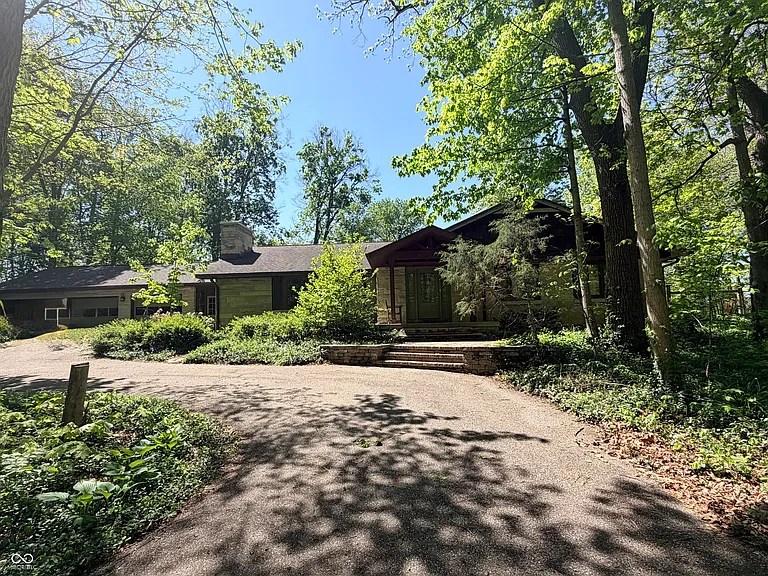
Here are two photos. The one on top is our present home, and the one below is the new house. Until we arrive and set up all that’s been packed will we be able to call it home.

Mrs. Chambers and Me

Most Christians are familiar with the devotional classic, My Utmost for His Highest by Oswald Chambers. But do you know that he did not “write” it or see to its publication? That was due to his wife, Gertrude, whom he married in 1910. Because he had a sister named Gertrude, Oswald called his wife “Beloved Disciple,” shortened to BD and then Biddy.

Oswald Chambers was a Baptist evangelist with an emphasis on holiness, born in Scotland in 1874. He traveled in Scotland and England; and in his last years, he was associated with the YMCA as a chaplain in Cairo, Egypt. He died at age 43 in 1917 after a hemorrhage following an emergency appendectomy. His wife, Biddy, returned to England to care for their child, Kathleen.

During Oswald’s life, Biddy not only listened to her husband’s messages, but she used her secretarial and stenographic skills to take notes, writing down all his words. After Oswald’s death, Biddy decided to get his messages published. She took her notes and typed out the manuscript for publication. That first book, My Utmost for His Highest, was published in 1918 and has never been out of print, having sold more than 13 million copies.

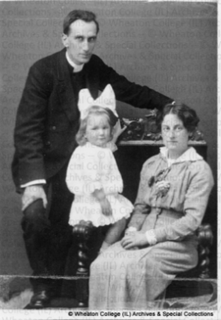
Biddy continued to pursue publication of 30 books by her husband. This task proved that Oswald and Biddy longed to do their “utmost” for their God. Biddy was 10 years younger than her husband, and they were married for 53 years. Biddy died at age 83 in 1966. Their daughter, Kathleen, lived to be 84. Here is a photo of the family when Kathleen was young.

Now this introduction leads to the reason why I’ve written about Biddy Chambers. I can associate with her in some ways. I did take notes on Bill’s sermons, but not to the extent that I got every word down. Bill’s messages were taped at Asbury College, camp meetings, and during his last pastorate, World Gospel Church, in Terre Haute, Indiana.

These messages have currently formed four published books and a weekly podcast, Words of Endearment with Bill Coker. I did not wait until Bill died in 2024 to start compiling his messages for publication. Earlier, when I would encourage Bill to write a book, he would always answer, “There are enough books out there.” But when Bill contracted Alzheimer’s disease, he could not object to my getting his messages published.

These began with the book, Words of Endearment: The Ten Commandments as a Revelation of God’s Love. When Bill saw me writing on a typed sermon, he would ask what I was doing. Avoiding the word editing, I said I was moving his words from speaking to reading. That satisfied him, and he was excited to see the printed books arrive. The other two books of sermons are: The Scandal of Christmas and Let the Church Be the Church. The fourth book is a collection of his pastoral prayers: Prayers for the People: from the Heart of a Pastor.

After Bill’s death, the two tech guys who put together the podcast continued to do the mix and download the episodes, with my writing the intros and outros and a host reading those. I’m grateful for their consistent work to have a podcast every Wednesday. You can listen on most servers and purchase Bill’s books on Amazon.com.

So Mrs. Chambers and I have set out to leave a legacy of our husbands’ works, and while I’m sure that Bill’s books will not reach 30 million sales, I am confident that his messages have and will continue to teach people from God’s Word. That’s the main reason for pursuing this ministry. Thanks to all who have read Bill’s books and listened to his podcast.

Another Move

Growing up in Alabama and Louisiana, my parents rented houses for our family of six. Whenever the owner wanted to put the house up for sale, we would move. I got used to (kinda) moving from one neighborhood and a different school during my childhood and teen years. We made friends easily, but adjusting to a new school had its drawbacks. Most often the school was within walking distance from our home, but in high school, my sister and I rode a public bus to and from school. Often after school let out, I would take a bus to the downtown library. Before going to study or look for books, I visited a small nearby restaurant and ordered French fries and a cold soda, not spoiling my appetite for supper. If it was dark when I got off the bus, I would sing as I walked a few blocks home. I thought that would keep me safe.

I married Bill, who already had an appointment at a small church in North Biloxi, Mississippi. We stayed there for two years, and he also taught English in the high school. Many of those students kept in touch over the years. We then moved to a four-point circuit in the country, and Bill arranged a schedule to preach at each church every Sunday. Some of those members kept in touch after we left. The reason for our move at that time was Bill needing to start seminary in Kentucky. To provide for our family, he took an appointment at a church. I marveled at how he kept up with studies while preaching each week. Twice we moved, due to new assignments––and churches adapted to our growing family.

After graduating with a master’s degree, we moved to Indiana, to be close to Cincinnati, Ohio, where Bill started his pursuit of a PhD at a Jewish university. He traveled on Saturdays, between school and church. Our time also involved two different church appointments. By then we had four children. Before he completed his dissertation, Asbury Seminary contacted Bill with a proposal to teach while a professor was on sabbatical. Bill secured a church, but we lived in a duplex owned by the seminary. After two years, Bill moved from the seminary to the college across the street, and we moved into college housing.

After many years as a professor, we ended back in a pastorate, again in Indiana. Bill pastored World Gospel Church for 19 years, and we had a house built. After retirement, Bill contracted Legionnaires’ disease, followed by dementia. When that progressed to needing help, we moved to Indianapolis to live with our daughter, Becky, and her husband, Paul. Our oldest son pastored a church in Ohio, and our two other sons lived and worked in Kentucky.

That brings us to the present: another move. Becky and Paul have closed on a different house in Indianapolis, and we will move by the end of July.

Here is a photo of the house in a wooded area. This will be a good move.

What the Lord Requires — Bill Coker, Sr.

Excerpts from Bill’s journal – spring and summer of 2002.

May God forgive me for grieving over losses rather than rejoicing that He is always at work in every situation for good. He never abandons us to circumstances—life’s dark valleys or those who stand against us. Somehow, my preaching must always bring this joyous truth to those who are hearing. I remember Dr. Robertson’s words in the seminary class on preaching: always end every sermon with the good news. This is Gospel preaching.

The idea of “centering” takes on greater meaning and significance as I understand more what it is to pray and what it is to develop spiritually and be truly sanctified. The clean heart is not only purified; it is unified, no longer ”a heart and a heart,” but whole and in union with God and reality.

Evelyn Underhill writes that recollection brings one’s attention under the control of the will. Here is the first step in meditation, which she refers to as “the halfway house between thinking and contemplation.” To focus on one thing until multiplicity merges into unity. This morning I’ve tried to focus on “the holy,” the central idea for this Sunday’s sermon (“The Hallowing Spirit”). Only with consistent and dedicated practice will I begin to learn how to meditate.

I should not be concerned with trusting my present feeling, for it will change. What matters is whether one’s whole intention is conducive to one’s proper and desired end. The eye of one’s intention, therefore, must be cleansed so that it is single and right.

One theme I have noted repeatedly over the years is integrity. That’s blamelessness, purity, and holiness throughout Scripture. The key is, as à Kempis noted, that the eye of intention must be cleansed of self-interest, a thing impossible even to think, except for the grace of God. Kierkegaard was right: purity of heart is to will one will, and Wesley’s language, that of perfect love, is descriptive of the same truth.

I think of Micah’s oft-quoted passage: “What does the Lord require of you but to do justice, and to love kindness, and to walk humbly with your God?” (6:8). In Micah’s statement, the same concept of “single intention” can easily be seen. Sometimes I wonder whether my spiritual life is being critiqued more based on what others say I should do than on my being led by the Spirit. At the same time, I am aware of the danger of rationalizing my inadequacies. May God be my judge.

Giving Away

My daughter, Becky, and I have been giving things away. But with different reasons and methods. In addition to gifts, she’s using online services to sell items. Some she’s had for a long time (such as a metal milk jug), others she inherited from her mother-in-law, such as a coffee table. She’s good with the process she chose.

My reason is quite different, for while I think of things I don’t need, I also want to prepare ahead for when I leave this world. So I take a photo of an item and send it to our sons, asking if they want it. Such as, our wall chiming clock. Now that will have a home. Our oldest son, a pastor, wants two communion sets––one crafted in wood by a friend and the other my husband bought to use when he worked Emmaus Walks. Our son will also receive the gold ring band that his dad had made for me, with a Scripture verse in Hebrew. “I am my beloved’s; and my beloved is mine” (Song of Solomon 6:3, ESV).

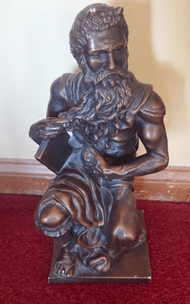
No one asked for this two-foot statue of Moses. And I can understand why. It might have been a present from my husband to my mother, or maybe the other way round. It has had a place in our living room. The only use I’ve found: it does make a good door stop. You might notice the horns on top of Moses’ head. Those represent a misinterpretation of Scripture, but I don’t know the reference.

Becky and I have a china cabinet in the dining room, filled with crystal, glassware, and an assortment of dishes. We’ve inherited items and some we’ve collected. They are now combined, so they will need sorting. I have a complete set of fine dishes that my mother-in-law gave us when we got married. I would use them for special dinners. Who will want to add these various items to their own collection is a good question. I’ll wait for family to visit and ask.

So I continue my occasional times of giving things away. It’s not a constant routine in my schedule, but I like offering objects to our children. Of course, they have their own homes, and they don’t need more “stuff.” Some things will go to grandchildren, and eventually Good Will gets a bunch. All’s well that ends well. I would like to know ahead of time who gets what, and that wish probably won’t get answered.

I Notice Kindness

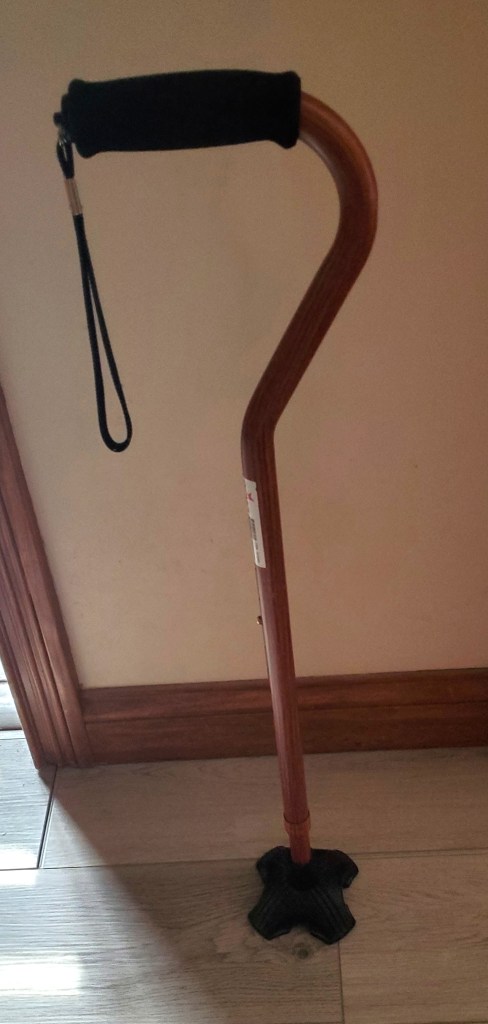
My cane goes everywhere with me – outdoors and indoors. I’m dependent on its strength to give me stability and balance, and I think it prevents falls. I bought it at a drugstore in Brazil, Indiana, after I had my right knee replacement almost 20 years ago. After recovery, I put the cane aside, but I’m glad I kept it. That’s because the cane has now been my constant helper due to arthritis.

Of late, I’ve noticed how my use of a cane has brought out kindness in people, friends and strangers. At church, the post office, and at any store that doesn’t have automatic doors, people offer to open the door for me. I would always say a word of thanks. Then I started saying, “God bless you.” Once at the post office, I gave that blessing, and the man (a stranger) who helped me through the doors said in return, “Thanks.”

Thus, I’m convinced that we do still have kind people in the world. While I could open doors for myself, people who see me, walking toward the building and using a cane, open the doors. It’s as if they know the right thing to do. I am grateful.

Doing What I Most Want — William B. Coker, Sr.

This week my memoir about the caregiving of my husband, Bill, is being published,* and that led me to look again in Bill’s journal for a comparison of what he was like before Alzheimer’s disease took control of his life. What did he want most to do? The constant theme of Bill’s serious talks during dementia was: “Do what’s right and do what’s good.” That had a basis in his desire to please God in all that he did. Following is an excerpt from his journal.

“How foolishly I keep piling up things to do…. So much I want to read, and the day is full without accomplishing some of what I’d like to do…. But, I am doing the thing that I most want––to serve the Lord, be busy in ministry that affective. Just wish I were more disciplined in scheduling what I do….

“I must not let my latter years be determined by the earlier. However long God allows me to continue, my voice and my life must be His to use. My people must have such if I am to lead them––lest I be like the unfaithful watchman in Ezekiel’s prophecy. [13:8–12; 33:1–6]

“I do sense God’s working in me in a more profound way, transforming me, conforming me to the image of Christ in a way I have longed to see. I also am aware of my need to ‘practice grace’… as Romans 6 so graphically reminds us. Right now, I need to slow down, lest I crowd out the very times of being before the Lord, and allow weariness to dull my spiritual sensitivities. I must be sure that what I accept is what the Lord wills and not for the sake of gratifying my own ego. I need time to pray this morning––time to be refreshed and renewed by the Spirit. I’ve felt so overpowered by what I’ve had to do that I’ve not done what I’ve wanted to do.

“May God forgive me that I’ve grieved over losses rather than rejoice that He is always at work in every situation for good. He never abandons us to circumstances––life’s dark valleys or those who stand against us. Somehow my preaching must always bring this joyous truth to those who are hearing. I remember Dr. Robertson’s words in the class on preaching: Always end your sermons with the good news. This is Gospel preaching.”

You can continue to hear Bill preach on his podcast, Words of Endearment with Bill Coker. Tune in with most podcast servers. A new message is downloaded every Wednesday. He is currently finishing the book of Ephesians. A new series on the book of Colossians will follow. ~AC

*An Honest Caregiver: Facing the Reality of My Husband’s Dementia

Distractions as Entertainment

My rotary (home) phone did not cause me to be distracted with various posts, for its use was only for connections: to and from family and friends. But social media on my cell phone has wasted my time. The trouble is not with the phone but with me.

I’ve made many vows to control time with distractions on my phone, but I’ve broken those vows too numerous to count. I do attribute some time to mere entertainment coming from that convenient device in my hand. But time passes, and useful skills, such as my writing, diminish.

Recently, another avenue of distraction has caused me to waste time, but I rationalize its benefits. Surprisingly, it’s a new nightgown. I bought it because I needed winter sleepwear. My fascination is with its design: on a white background are cardinals, red berries, and grey twigs. The fabric is recycled polyester, but with the feel of velveteen. Some cardinals are slender and others are robust; all have black around the white eye, a red top-knot, and a faint yellow beak. The berries vary in number alongside the grey twigs and leaves – one, two, or three.

As I said, I look at this gown with fascination, noticing the variations. They remind me of my hobbies of coloring books and crossword puzzles. One connects with colors and the other with words to adequately describe what I see. So, I rationalize away this time, not as wasted but productive. I only post this about myself, for perhaps I’m not the only one who deals with distractions and wasted time on a phone (and a nightgown’s design ;-). Should all of life be serious without entertainment? But too much of a good thing can be wasteful. Do you agree?

This Year I Purpose To

Making lists is a good habit I have. Several years ago, Ann Voskamp provided a way to begin the new year with a list that has purpose. She listed the items in caps, and each person fills out the rest. I think having purpose for each day is important, helping me to connect with God’s reason for serving Him and others. So here is my list for the New Year.

2026 This is the Year I Purpose To

EMBRACE joy and delight

ENGAGE my mind and heart

BE a loving mom and a good helper

BELIEVE God answers prayer

BREAK habits of distraction

DAILY read and pray and write

DO the hard work of a writer

LET GO of fear and insecurity

LEARN more about writing books and posting blogs

LIVE with a hopeful outlook

GIVE my best for the sake of others

GROW in knowledge, understanding, and wisdom

Now it’s your turn to live with daily purpose.

It’s Time to Make a Choice

In late December I choose which devotional book I’ll read alongside my Bible for Quiet Time each morning. I encourage you to join me in reading devotionals. To help with your selection, I’m including some of my favorites.

            As a young teen I began the habit of reading a daily devotional book. I still recall how vividly God spoke to me through those “two listeners” in God Calling. Through the years I’ve found that when placed alongside Bible reading and prayer, devotional literature is valuable to my Christian growth.

            My Utmost for His Highest by Oswald Chambers is a devotional classic. On day one the author invites the reader to make an unreserved commitment: “I am determined to be absolutely and entirely for Him and for Him alone.”

            Thumbing through the pages of Morning by Morning by C. H. Spurgeon, I remember personal events. The year I read this book we cared for my husband’s mother who was dying with cancer; our first grandchild was born; and my father died. Beyond these personal ties, I value this book because Spurgeon exalts Christ, intertwines Scripture and hymnody, and highlights creation.

            Several times I have read Streams in the Desert by Mrs. Charles E. Cowman, co-founder of Oriental Mission Society (currently One Mission Society). Because she compiled this volume during the six years she nursed her sick husband, the lessons speak to the hurting, the persecuted, the doubting. Her theme is confidence in God.

            Although I’ve read other books by E. Stanley Jones, I prize The Way to Power and Poise. His central theme is the ministry of the Holy Spirit, a relationship that produces a Spirit-controlled life.

            Hannah Whitall Smith is best known for her book The Christian’s Secret of a Happy Life. In God is Enough, editors Melvin and Hallie Dieter have compiled daily readings from nine of Smith’s books. Through the heartache and sorrow in her life, Smith affirms God’s sufficiency.

            In my view you cannot find a better resource on prayer than The Meaning of Prayer by Harry Emerson Fosdick. The chapter on “Prayer as Dominant Desire” made me examine my motives: Did I truly want what I prayed for? Or more exacting: Did I pray for what I wanted?

            A few years ago I discovered Disciplines for the Inner Life by Bob and Michael Benson, father and son. The format includes prayers, Scripture, hymns and excerpts from a broad base of Christian writers. In each week’s topic I found new truth to pierce my self-righteousness. Keeping a spiritual journal helped root the lessons.

            One year I read Each New Day by Corrie ten Boom, who tied together truths of experience and Scripture. The next year I selected Diamonds in the Dust by Joni Eareckson Tada. Through her struggles to accept her disability, she has found in Scripture many “diamonds” which have made her “rich in faith and wealthy in hope.” This past year I read Wisdom For the Way by Charles Swindoll, excerpts from his several books. Brief but powerful daily reflections.

            Not meant to be a devotional book, I must include one by Evelyn Underhill, my husband’s favorite author. While you might have to find it in a used bookstore, I recommend the volume which includes: The Fruits of the Spirit, Light of Christ, and  Abba. She has a style that touches the heartstrings with intellectual precision.

            In recent years, I’ve found current authors who have collected devotions from earlier saints. Such are: Take Time to Be Holy by Samuel Logan Brengle, edited by Bob Hostetler. Another by Hostetler: The Bard and the Bible, the Bard being Shakespeare. Two compiled by James N. Watkins: Intimacy with Christ, includes classics by Brother Lawrence, Francis of Assisi, and others; and The Imitation of Christ, devotions by Thomas A. Kempis, in today’s language. I also include one of my favorite current authors who, among her 50 books, wrote Jesus Every Day: Prayers to Awaken Your Soul.

            I’ve introduced you to some of my favorites. These you may consider when you make your choice. Look them up online to better acquaint yourself with authors and topics. Then choose for yourself a devotional guide to read on a daily basis by matching the book to your personal, present-day need. God will speak to you through His saints.