Blog

Why do people do what they have to do?

Isn’t the answer to this question obvious? If you have to do something, you do it. But we often put off what’s even important and what’s required. I studied this question while altering a dress: Why am I doing what I have to do? I simply could not delay, for I’m to wear the dress at our granddaughter’s wedding tomorrow. So the process is a have to, not something I can put off until later. The date of the wedding is my motivation.

I pondered this question over 30 years ago when our soon-to-be son-in-law came for dinner. Paul asked, ‟How long before we eat?” He then used that bit of time to make phone calls to a few of his church youth group. Listening to his end of the conversation, I could tell he was connecting well, asking about their day and such. After he finished his calls I complimented him. Paul confessed that he did not like making phone calls. ‟Then why are you doing it?” He said, ‟Because the teens like using their phones.” These brief phone calls helped him stay connected with the youth. I venture to add that this practice could probably not be found in his job description, but Paul used it as a means for better relationships, even when he did not like doing it. That won my appreciation for this youth leader and future family member.

Those examples give us two reasons why people do what they do. One, there is a deadline, a have to get it done kind of thing. Two, we do what other people like or what makes them feel appreciated. We could add other examples to that latter reason. Husbands and wives, moms and dads, anyone on the job will perform unpleasant acts simply because the other person likes it that way. It could be how to fold towels, which way the toilet paper rolls, being on time for dinner, finishing an assignment before the deadline. You can add a dozen more samples. That now son-in-law doesn’t like to gather and take out the trash on Thursday nights. After some years of my daughter doing that task, Paul took over. He said, ‟It must be done, life goes on.”

Number three is duty, taking care of responsibilities, a great motivator. When our children participated in sports or gym at school, uniforms were required. I had to be on top of laundry requirements and get those gym shorts washed or get the grass stains out of baseball uniforms. One morning I awoke and remembered that one child needed cookies for school. It got me out of bed early. She had volunteered her mom to bake cookies for a classroom event.

So think about that question—personally and corporately—and see what answers you develop. Why do you do what you have to do? Apply the question to those at work and even to your children. What’s behind us, pushing us to do something? What drives us to perform?

Window Musings

Sitting at my desk at church, I’m gazing out the window. Earlier I had been thinking of Evelyn Underhill’s meditations on the Lord’s Prayer, some perceptive ideas on the significance of Jesus’ petition, ‟Thy kingdom come, Thy will be done in earth, as it is in heaven” (Matthew 6:10, KJV). Underhill’s lesson on the Lord’s Prayer has profoundly challenged me.

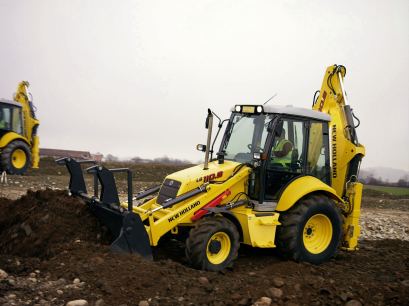
However, looking out my window and watching the construction going on, my thoughts have moved from the spiritual to the mundane. I have been absorbed in watching a backhoe digging a rather deep trench across our former patio. Sitting at the controls is a woman—not something I would have expected to see—intently maneuvering the extended shovel and scooping out precisely the amount of dirt necessary to be removed for whatever purpose the trench is being dug.

backhoe2

Her face betrays no hint of a nonchalant attitude; she is serious about her job and intent on doing it right. Being a woman in a position where one might ordinarily expect to find a man, and the only woman on the construction site, one might easily assume that she may be a bit self-conscious. Then again, maybe past experience has already earned her place behind the controls of these earth-moving machines.

Needless to say, spiritual parallels are begging to be drawn. I am struck by the power of the backhoe. It’s not a large machine, as earth-moving equipment goes, but as it bites into the dirt and scoops up shovelful after shovelful, it does so with no strain on its engine. It was built for this task. I think: Oh God, you have made your Church for tasks far greater than it often performs; yet so often we strain even at jobs that are much smaller.

I am impressed by the woman at the controls. Surely, she has been told numerous times that this was no place for her; but she refused to be denied. Had she, like many a little boy, dreamed that someday she would operate such a big machine and persisted until she got the job? So I muse: Oh God, how many times have we given in to the suggestion that the job was too big for us, or that this was really a job for someone else? Have we been persistent enough in reaching for our dreams, those urgings that came from you?

The expression on the face of this backhoe worker is intense as she carefully removes the right amount of dirt. I know that hours of practice have honed her skill to manipulate the shovel to do what she wants it to, and I have enjoyed watching as she has guided its reach and its retrieval. This observation has led me to think: O God, how intent have we been in doing a task far more important than digging a trench? You have commanded us to go into all the world and make disciples, and sometimes we are so casual in our response. We have too frequently lacked the intensity of this woman on the backhoe in developing our spiritual skills and in doing the job you have given us. Lord, teach us how to dig.  ~William B. Coker, Sr.

Adapted from the World Gospel Church newsletter (several years ago)

3 Things You Should Know

As the east sun comes through our bedroom window I awake each morning to read a plaque written in fine calligraphy. I study the impact these imperatives should make upon my life.

Plaque

‟Whence thou hast come”: I’m thankful for my godly heritage. My Christian parents taught me how to apply biblical knowledge. From them I learned what a family looks like, how respect should be sewn in the fabric of my life, the importance of an education, and the value of speech (what to say and not to say). But when I put a personal twist on ‟from where I have come,” I must give praise to God who saved me from being a good little girl to being redeemed and striving to be Christ-like. As the saying goes, I have come a long way.

‟Whither thou goest”: Eternal life is mine. I know I will spend eternity in Heaven with Jesus. But until then, it’s also important to know where I’m going here on earth on a daily basis. Each morning I ask what I’ll be doing, what is my purpose, and how will I fulfill it that day. God has given each of us a purpose in life, a goal to accomplish not only at the end of life. At church our pastor reminds us each Sunday morning that we have only three things to do: ‟Love God, love others, and serve the world.” That’s a lot to do in a day, but it’s worth setting our minds to doing.

‟& before Whom thou shalt stand”: This is the most important of the three imperatives. One day each of us will stand before the One who made us, who sustains us, and who has given us His grace for daily living. But do we know Him? Do we know who God is, what He is like, what He has done for us? God the Father gave His only Son, Jesus Christ, as the sacrificial Lamb to pay for our sins, for my sins, your sins. Jesus is the One before whom we will stand. ‟This shouldst thou know.”


Almost but Not Yet

Soon I will start my last year in the 70’s. But as mother would point out, when I have a birthday then I’ve begun the next year. When I celebrate my 79th birthday, I’ve finished that year and in my 80th year. Not what I want to hear. Mother is correct, though, for I’ve completed 79 years and on that day I start the next year. She would say, ‟I’m in my 80th year.”

You see, when we are born we are already nine months old. When we celebrate our first birthday, we have completed that year (and more) and start our second year. Complicated? Not really. It’s a matter of calculating correctly in the amount of years we’ve lived.

Then there’s the association of how one feels and one’s age. In my mind I don’t feel 79 (or 80). I look back in time and I don’t feel either young or old. But in my body I sometimes feel older than the years since my birth. I look in the mirror and often see my mother. Except for my skin; hers was smooth, few wrinkles or brown spots. Except for her hair; she had more grey at age 80. It’s just the age that shows on me. But she lived past 90.

Where am I going with this? Nowhere in particular. I’m having a birthday and that causes me to reflect. I want to go somewhere, perhaps make more use of the years that are yet to be.

Jack London, journalist, wrote: “The proper function of man is to live, not to exist. I shall not waste my days in trying to prolong them. I shall use my time.” I’m not so sure about all of that. And I’m curious what you think of it.

Connecting good writing with my spiritual life

Today is the one-month-away date for Chrissa’s wedding. Lots of plans and doing, but life goes on. While Becky bakes for the wedding, she also plans and cooks for the church youth Purity Weekend and college exam treats. Becky seeks to ‟maintain relationships with others and keep [her] creative edge, while also doing everything else in [her] life” (Dan Balow, a Laube agent).

For myself, I have been taking some online courses in writing. That’s what I want to do, what I do, what’s considered my job. I’m serious about writing—articles and a book as a WIP (work in progress). As I took notes on these classes and also read the daily blogs from The Steve Laube Agency, I began to see some connections between good writing and good spiritual growth. So I have to give credit where it’s due.

Balow also wrote: ‟The successful author-life is equal parts creativity and discipline, make-believe and real-life, story-telling and deadline-meeting.” I can hear you now, that doesn’t sound like spirituality. Give me a chance.

When we get creative with our discipline (writing or spiritual) we will accomplish more and enjoy it more. Story-telling can be our own testimony. Link that with a deadline to share and we become more passionate about spreading the Good News. Now you may have me on the make-believe and real-life part, but let’s consider it. Children are caught up in their make-believe world for play is their job. It even prepares them for real life as they are good imitators of parents and teachers. Perhaps we could learn something from the children in our lives. The Apostle Paul commissioned us to imitate Christ.

‟In the Gospel of Luke, the fourteenth chapter, Jesus tells a couple of parables and then sums them with a ‘count the cost’ statement which could be taken any number of ways, I suppose, but relates to a person living life as a believer. Have no illusions, there is a cost” (Balow). Sum it up and make the connection: ‟Successful authors [and Christians] already counted the cost and decided it was worth it” (Balow).

More on this to come another time. AC

Gleanings – Easter Sunday – Pastor Robert Hock – Southport Presbyterian Church

My notes from Pastor Rob’s sermon this Easter Sunday morning:

The tomb is empty! Why ought we to care?

The Gospel means Good News. Yes, I know that, but what I did not know is the historical significance. Such as when victory prevailed over battles, the men “spread the good news” (see 1 Samuel 31:9). There was a need to tell.

Mark opens his book with: “The beginning of the gospel of Jesus Christ the Son of God” (1:1). In ancient Greek the word gospel is always plural, but here Mark breaks the tradition and uses the singular form of gospel. There is no news as good as this Gospel. The remaining of his book explains the purpose of this good news. He has to tell it. Peter proclaims Jesus as the Messiah (8:29), and the soldier near the Cross said, “This man really was God’s Son!” (15:39).

Today, Easter Sunday, we proclaim the good news that Christ has risen. You would want this to be true, for it’s a story of God who loves you!

The Gospel is not advice (counsel), for that means we need to do something. It’s on you!

The Gospel is a report of what has already happened. The Gospel takes the burden off you. It’s on Jesus! Our part is to come, receive. It’s grace and hope. God comes to find you. He seeks to set you free!

“And Can It Be” by Charles Wesley

He left His Father’s throne above/ So free, so infinite His grace/ Emptied Himself of all but love . . . Long my imprisoned spirit lay/ Fast bound in sin and nature’s night . . . / I woke, the dungeon filled with light/ My chains fell off, my heart was free/ I rose, went forth, and followed Thee.

I repeat: You would want this to be true, for it’s a story of God who loves you.


Good Friday – A Year Ago

At the 2017 noon Good Friday service in Terre Haute, IN, at Free Life Community Church, Bill gave one of five messages shared by pastors in the community. After the service Jean Kokoska met me at the back of the sanctuary and said it was a blessing to hear Bill preach again. I asked if she noticed how Bill repeated some points in his message. She said that didn’t matter and, “maybe we needed to hear it twice.”

That was Bill’s last sermon. Bill’s active ministry is over but the fruit of his preaching and teaching continue to grow.

I am a testimony to my husband’s teaching. I have received most of my scriptural knowledge from his messages over these more than 60 years. So I give thanks for God’s call upon Bill’s life, and give God the glory for his ministry.

As a member of Carrollton Ave. United Methodist Church in New Orleans, LA, I heard Bill’s first sermon. He preached on “I am the way, and the truth, and the life” (John 14:6). Bill was 18 years old when God called him to preach. We were married four years later when I was 18. God is good. Don’t you agree?


Gospel and Culture — Guest Bloggers

In a notebook dating back to 1984 I find notes from Dr. Phil Thornton’s mission class (PT) at Asbury College. This contains references from Anthony Campolo’s “Ways We Distort the Gospel” (AC) and Don Richardson’s book/movie Peace Child (DR). I now quote (or perhaps misquote) from these sources as I reflect on the above subject.

Worldview can be either religious or secular, a sense of judgment and values bound up in language, an ever-changing culture and integrated system of values. What is it like to be a North American in another culture? Majority rule is generally the norm in N.A. In Japan, for example, the majority will more often compromise for the minority when a decision affects them.

We think that if a person is not involved in the solution, he is assumed to be part of the problem. This raises questions about value system, for values come out of one’s cultural background. It’s part of one’s unconscious behavior, usually logical to that person. Listen to others in order to understand and affect change into a Christian perspective. (PT)

We tend to impose our own traits onto Jesus and Christianity. We see Jesus as white, American, Protestant, and Republican with all its middle-class traits. Americans see success as the ultimate best and failure as the ultimate worst. We could see Jesus as a failure, for he died young at the peak of His ministry. Jesus exalted the losers – look at the twelve disciples. Jesus walked with the lowly, not the potentates. A Christian lifestyle is one lived sacrificially for other people. Introduce yourself and others to the Man of Sorrows, acquainted with grief. We are not to make people disciples of Uncle Sam, but of Jesus Christ. We are losing our young people not because we are presenting a Gospel that demands too much but one that demands too little. (AC)DR Market.CG

Every culture has a key that unlocks the meaning of Scripture, a form already there to hold the meaning of Truth. How do we determine a dynamic equivalent appropriate to another culture? When we look at the impact of a biblical injunction we discover the meaning and function. For example, “Greet one another with a holy kiss” (2 Cor. 13:12). The dynamic equivalents involve translation, church, and conversion. (DR) My interpretation: Function is a kiss; meaning is a greeting. Now compare the biblical injunction and today’s culture wherever we live.

That’s it for a trip back to a college class and what I think is still important for a worldview.

Gifts and Giving

Our granddaughter Chrissa is registered at several stores for wedding gifts. That’s expected when you announce your wedding and send out invitations. What a nice practice—for the new couple is starting out with needs for their home and lifestyle. It’s the way of American weddings. I don’t know of customs in other countries, but our custom is nice and practical. So the bride and groom pick out items at the stores and form a registry. Family and friends present these gifts at bridal showers or on their wedding day. Online gifting also provides easy access. Gifts can even be sent to their new home. How efficient is that!

I get to see and hear all this happening since we live in the Coker/Gearhart home in Indianapolis. Chrissa is home, having closed out her ministry in the Dominican Republic to start a new life in North Carolina with Léo Silva who works there at a Christian camp called Rockfish. The wedding ceremony will be held in our church here so that is a gift of location. The marriage of a daughter is different than that of a son. My experience came with Becky and now she is having the joy of planning and preparation.

What I will wear at the wedding is no longer a question. A lady in the church has offered me her grandma-of-the-bride dress. At first I wondered if I could fit into the dress and would it be too much to accept. But I tried it on (a perfect fit in size and length) and the family agreed on the look—so it’s mine to wear. What a gift! And this doll of a lady doesn’t even know me. She and her family are good friends of the Gearharts. What a blessing! I’ve been given a gift of love. And that’s what a wedding is all about.


Faded Memory

This memory lodged in the back of my head with not many details. Yet it would pop up and haunt me for years. I could describe the setting and a few characters, but not the reason for the activity. It wasn’t until after Daddy had died that I asked Mother if the image was actually an event that happened. For I thought it must likely be my imagination associated with something fearful.

Setting: a room with little furniture. A dark couch and coffee table set against the wall on the left of my scene. Straight ahead was a little table. Nothing on the top of either table. Between these and in the distance a door opened and three men walked in. Were they invited or did someone greet them? I recognized my dad between the other two men. Nothing else happened.

What was it all about? Something significant? A memory or a dream? Was I the one viewing the scene? Did I have reason for that lingering fear? Where was Mother?

Mother had the key to these questions, but it look me years (too many years) before I asked for answers. Yes, it was a true event. And Mother was there and knew what happened.

The men had brought Daddy home from the office and he would soon be admitted to the hospital with a nervous breakdown. I don’t remember how long he stayed. What I do know is that he had an obsession about cleanliness – either before or after the hospital stay. He would constantly ask Mother to “wash Ann’s hands.”

I can still see the original memory, but now I place details within the setting. Reasons for the event make sense, but it’s a faded picture hanging sideways in my memory bank. And no fear lingers.