
Blog

Pastor Appreciation: Integrity

5-3-14 336Carrollton United Methodist Church, New Orleans, LA, where Bill was called to preach.

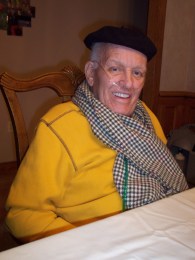
‟When we come down to it, the whole issue is a matter of integri­ty; the willingness to ask ourselves the really hard questions and seek to answer them with a total commitment to the truth.  Without integrity, everything else is cheapened, even the truth which we may be seeking to espouse. If Jesus taught His disciples anything, He taught them that He was THE TRUTH; that they would know the truth, and the truth would make them free; and that they would proclaim the truth to a world that was in the darkness of untruth.” That’s my husband/pastor’s writing. For me, Bill embodies the valuable quality of integrity.

In this month of October, the church and probably Hallmark promote pastor appreciation. For most of my adult life, Bill was both husband and pastor to me. And I’ve been blessed with both relationships wrapped into one.

I hope that you can say with me in regard to your pastors: ‟You are full of goodness, filled with all knowledge, and able to instruct one another” (Romans 15:14), ‟serving as a priest of God’s good news” (v. 16). ‟Therefore I rejoice over you” (16:19b).

In 2008 Bill retired from World Gospel Church as senior pastor and then began a few years as volunteer associate pastor at Free Life Community Church. Both churches are in Terre Haute, IN. Now we attend Southport Presbyterian Church, Indianapolis, IN, and we’re grateful for Pastors Rob Hock and Glen Massey who preach the Truth. At the beginning of Pastor Rob’s messages he says, ‟Before we go to the Word of the Lord, let’s pray to the Lord of the Word.”

Bill’s sermons always included teaching and were always founded on the Truth of God’s Word. His delivery only matched his message in presenting the Truth. To all these men of truth, I send my appreciation for your messages and your lives. I have been/am blessed.

Pastoral Prayers

WGC.artist's view

During his 19 years as senior pastor of World Gospel Church, Terre Haute, Indiana, Pastor Bill Coker led the congregation in prayer during the Sunday morning worship service. After he had already prepared his sermon during the week, he moved his attention to the pastoral prayer.

Bill’s preparation of the prayer was as important to him as offering it. He set the time apart for preparation – to be in tune with the Lord and the congregation. The writing happened on Sunday morning at the church, before anyone arrived, alone with God and thoughtful of his responsibility as shepherd of the flock God gave him.

While I cannot write adequately about Bill’s preparations for his public pastoral prayers, I was in the congregation and heard those prayers for almost 20 years. He kept those typed prayers in 7″ x 9″ three-ring binders. I read them now, and they still have a current quality, alive and fresh.

In the worship service Bill’s prayers took about five minutes, perhaps a little less for bidding prayers. His pastoral prayer would come in the early order of the service after the praise team or choir led the congregation in singing. Often the opening part of the prayer would include praise and thanksgiving, referring to the preceding worship of  music, perhaps adding a line from a hymn. The bulk of the prayer focused on the needs of the people — church, community, nation, world.

These pastoral prayers were addressed toward our heavenly Father. Not meant to bring any recognition to the author, the prayers only brought glory to the Trinity—God the Father, His Son Jesus Christ, and the Holy Spirit. Together we lifted our praise and thanksgiving to God and joined in requests and concerns related to the community of believers.

Perhaps pastoral prayers are a lost art today. What do you think?

Pointed

Sharpening a pencil to a fine point, I began to write, thankful for such a basic tool. I use a pencil to work crossword puzzles, for I’m not confident enough using a pen (like my daughter when she works Sudoku). I apply the pencil’s eraser for mistakes before looking up answers. In this one devise, a pencil, I can write and delete.

Applying this to life, I know God’s grace both when He gives strength for good deeds and His forgiveness for those mistakes (sins) I want erased. The eraser gets that point across, for we all need to rid our lives of sin and errors.

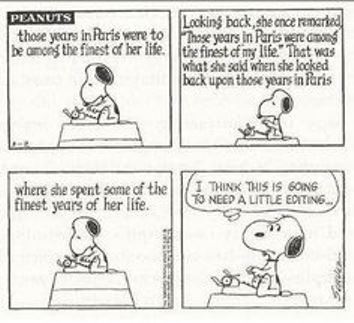
On a lesser scale but using tech devices, I type out a devotional or magazine article and the words appear on the computer screen. The editing process comes next, and with the delete button, along with cut, copy and paste, I can make the first draft more acceptable for submission to a publisher. It’s a technical improvement on a pencil with its lead point and eraser.

Snoopy.Editing

So this led me to pay attention to other uses of “point.” Our granddaughter, when complimenting her husband’s homemade dinner, wrote that the meal was “on point.” It was good!

After watching a movie one night Bill asked, “What was the point?” He did not understand (or agree with) the basic message behind the script. Our church’s missionary to Muslims in London relayed the time when he delivered his first sermon years earlier. The youth pastor had approached him and said that his exposition of the Scripture was great, but “You didn’t make a point.” In other words, the application was missing.

On Google I searched for the phrase “breaking point,” for I had heard a sports announcer say it. Along the side of the meaning, Google posted a song, “Breaking Point,” sung by Keri Hilson. That led me in a different direction – abused women who had reached their breaking point.

So what’s my point? I’m only reflecting on a word and phrase, making myself think more. This is, by the way, something I’ve learned that grade-school students these days don’t know how to do – think on their own. Think about this and make your own point.

Rule of Thumb

Rule-of-thumb

Not a precise measurement but ‟rule of thumb” is an expression that’s meant to be like a ruler or guideline. This morning I asked about dosage of vitamin C. How much? The answer is found in the percentage of a day’s value. So if one caplet of 500 mg has more than 800% of what’s needed daily, then taking more than one tablet daily is not advised. We want to enhance healing, but going overboard will only eliminate what’s not needed.

I once asked a client at CPC how she made decisions. When she wanted to know what to do, whom did she ask? Without hesitation she answered, ‟I ask my dog.” Uh oh!

This month I’m reading through the book of Proverbs (fits nicely with 31 chapters for one month) and Psalm 119. These are full of guidelines about God’s Law, the best rule of thumb for a good life. ‟Your word is a lamp for my feet and a light on my path,” therefore ‟I am resolved to obey Your statues to the very end” (Psa. 119:105, 112). Accepting correction is something I’m not good at: ‟But a person who accepts correction is sensible” (Prov. 15:5). Again in verse 32: ‟Whoever listens to correction acquires good sense.”

What’s your ‟rule of thumb” for living?

Call In the Experts

After we’ve done all that we could possibly do, trying all the home remedies and those from the internet, we called in the experts. They know. We trust their expertise as they work for us.Days Like This

So, what was the problem? Bed bugs. How they came to live in the house, mainly in Paul’s and Becky’s bedroom, most likely moved here from a summer youth camp. So here it is September and Becky & Paul still could see these bugs in their master suite. It became time for drastic measures. And I truly mean drastic, for while the experts would do their work, the family had to prep the house for the treatment. That meant putting all fabrics in the dryer on high heat for 30 minutes and then bagging the items and moving these large bags to other quarters. We had to think of bug-infested rooms as contaminated and not even fold clothes there. Thankful for the basement, we stored the numerous bags there.

Some of these items (such as blankets and linens) we brought to a laundromat on the day of treatment, taking about four hours to complete the process. While we spent the day away from the house, the experts applied 120° of heat to the infected rooms. Yes, bed bugs are killed by high heat. All our other methods had little success, for while some bugs were killed, they still multiplied. Heat is the weapon of choice.

I could give a spiritual lesson here about needing expert wisdom for problems we try to solve on our own, but I’ll not take the space for that. Make your own application. I’ll also not ask why God let bed bugs “on the boat.” For this writing I only want to thank our daughter and her husband for their hard and long labor and for finally calling in the experts.

Awake, O Sleeper

This could also be titled “Sleeps and Grogs.” I’ll explain later. First the serious part.

We are engaged in spiritual warfare and God has designed the appropriate armor. We find that in the sixth chapter of Ephesians. The ‟sword of the Spirit, which is God’s word,” is our best offensive weapon.

Every Soldier Needs a Savior

In the second part of John Bunyan’s classic work, The Pilgrim’s Progress, Bunyan introduces a character by the name of Valiant-for-Truth. He’s my favorite, for he is confident that Truth is on his side. His sword never gets blunt, and he never gets weary. Valiant said, ‟I fought till my sword did cleave to my hand.” It’s a beautiful picture of how truth is to be part of us. We do not put it down and pick it up again. Truth grows out of us so that we can fight with courage.

During my battle to maintain a consistent devotional habit, I asked a friend to call me early each morning. That was my true wake-up call. I knew I could not hit the snooze button and return to sleep, for she would call again to check on me. We are all called to wake up and pay attention to our conduct, walking as wise, attentive to the enemy’s schemes, and making the most of our time.

We are not to mimic my son’s friend who went to great lengths to get out of school one day. He got permission from his teacher to go to the principal’s office. His excuse? He had the ‟sleeps and grogs.” This high school boy described to the principal how it works. The sleeps and grogs start at his feet and work their way up the body and finally into his eyes and he can’t keep them open. He just can’t pay attention to his teachers in class. The strange outcome, to me, was that he got to go home that day. See what a little explanation can accomplish.

Someone has said, ‟Time properly conceived is a gift from God.” Let’s use our time wisely, equipped to fight the enemy and defend the Truth.

Eyes Open to Danger and Beauty

During an audio-visual lesson in Sunday school on Ephesians, J.D. Greear spoke of the transformation of a Christian life. He said that God’s grace restructures and affects change in our lives by way of danger and beauty.

Greear used the example of Frodo from The Lord of the Rings. Frodo left reluctantly on an adventure and encountered dangers along the way. But he also saw more beauty than he’d ever known back at the Shire. That couplet, danger and beauty, transformed Frodo’s life.

In my Christian walk I must admit that these two elements have made a difference. God’s grace has been active in crises and good times. Danger would not have been how I’d describe the struggles, storms, and stale times, but I see how it fits. Once in an actual storm, when we thought our son John and his friend were trapped at Chipmunk Creek, we feared the possible danger. But they had found safety, and of all places – in the old chicken coup turned clubhouse in our back yard. Our struggles involved job-related setbacks. Some relationships I would identify as gone stale. Yes, danger existed in all these.

And beauty: I rejoiced over the births of our four children, a beautiful encounter of cooperating with God’s created order. And when I think of the variety of colorful birds and other creatures, small and large, I add the joy of music and its splendid expanse of beauty. God has truly given us both personal and universal encounters with His beauty.

I turn to Scripture and find this couplet of danger and beauty as it relates to opening our eyes. Without expanding, I list these examples:

The Israelites in the wilderness: “You saw with your own eyes the great trials and those great signs and wonders” (Deuteronomy 29:3).

Elisha prayed for his servant: “Lord, please open his eyes and let him see” (2 Kings 6:17) the Lord’s army surrounding them.

Jesus gave thanks and broke bread at Emmaus: “Then their eyes were opened, and they recognized Him” (Luke 24:31).

And a closing example from fiction: In The Lion, The Witch, and The Wardrobe, Lucy asked Mr. Beaver about Aslan the lion. Mr. Beaver replied, “No, He’s not safe, but He’s good.” Even with the Lion of Judah, there is danger and beauty. Lion.Aslan

Source of Hunger and Satisfaction

Are you hungry? Do you yearn to be satisfied?  Rainbow Garden.JT

There is one source for both conditions. When reading Deuteronomy, 8th chapter, I saw something I’d not noticed before. You know how that is. The Bible is the living word, ever new and fresh.

Moses recounted the Israelites’ journey. God “humbled you, causing you to hunger and then feeding you with manna” (8:3, NIV). God put that hunger in His people and then He fed them. Immediately I thought of the beatitude: “Blessed are those who hunger and thirst for righteousness, for they will be filled” (Matt. 5:6). That hunger for righteousness comes from God, and He also supplies what’s needed to fill us. The source is the same for that hungry feeling and the satisfaction we receive when God fills us with His righteousness.

However, Moses also gave a warning. “When you have eaten and are satisfied, praise the Lord your God for the good land he has given you. Be careful that you do not forget the Lord your God” (Deut. 8:10-11) – that we assume our own efforts produced the benefits. Perhaps it would be appropriate to say the table blessing after the meal, when we are satisfied, to recognize the source of that satisfying full feeling. Just a thought. But I want to try it out.

Laundry Day

Friday is laundry day for me, and it’s my favorite of house chores. I remember the excitement on the day my mother’s new Bendix washer arrived, replacing the old ringer-type. This front-loader had a “window” (like my Frigidaire today). After the installation my sister and I placed a low stool in front of the washer and watched the various cycles – wash soap sloshing, rinse water filling up the tub, then spinning dry enough to hang on the clotheslines. It was like a special TV show for us girls.

As a teenager I helped with the laundry, including hanging out the clothes, bringing them in, folding linens, and replacing them in the closet (freshly-laundered ones on the bottom of the stack). When I was engaged to Bill, Mother gave me a lesson in the “right way” to hang clothes on the line. Clip Art.JD

For linens that meant attaching pins to each end of a towel, sheet, or pillowcase and connecting the same pin to the next item. Shirts and slacks hung from the hem; skirts and panties from the waist; socks from the cuff. We hung each separate item in groups – all towels side by side and so forth. This made for better organizing when bringing in the laundry to fold. Some I folded at the line, but most I handled on a bed.

We used oval wicker baskets to carry the laundry to and from the house. We sorted the laundry into the washer – a load of whites first, then light colors, and dark clothes last. All our sheets and towels were white so bleach could be used. We organized all linens in the closet according to use, folding towels and washcloths the way we wanted them hung from the racks. We changed bed sheets every Saturday and each sibling took care of stripping and then re-making his or her own bed. Mother’s storage system meant three of each item. One was being used, one being washed, and one stored away.

Those lessons learned as a teen have stayed with me throughout my own homemaking. At first I did use a clothesline and even had church deacons erect one for me when there was none. I especially liked to hang out sheets. Now it’s a dryer positioned next to the washer, and I don’t miss the clothesline chore. But the rest of Mother’s advice has stuck, assuming that I know the ‟right way” to sort and fold linens. I’ve been so attached to that theory that I often re-folded towels when someone helped me. Not good, so I’ve learned to accept the help and wait until my next turn to fold.

Ironing was not part of our laundry days growing up. Mother hired a lady to come once a week and her only task was to iron. Mother said, ‟If I had to earn my living by ironing, I would die trying.” That’s to say she hated ironing. So when I got married to a pastor who needed shirts ironed for Sunday, he taught me how to iron. In those early days before perma-press fabrics, we starched most all our clothes and cotton pillowcases. I recall using Argo or Faultless brands of laundry starch. Before ironing, I’d sprinkle water on the items and roll them up. If I sprinkled more clothes than I got to, I’d freeze those items. Yes, that’s what I did, for it prevented having mildew collect on them before I was ready to iron again. I learned that the hard way.

It’s rare now that I wash clothes and iron on the same day.  Yes, I still iron some items. This chore is preferably done in the evening, watching a music video or movie.

Never Alone

In the car yesterday I listened to a CD, The Best of the Tenors, with Carreras, Domingo, and Pavarotti. Among the selections sung in English I heard “You’ll Never Walk Alone.” I don’t know which tenor started off the song, but another joined in to make it a duet when the lyrics got to the title: “You’ll Never Walk Alone” and they repeat the chorus. Stirring performance.

But what made me enjoy the song most was remembering that Bill introduced this song to me when we attended Carrollton Methodist Church in New Orleans, LA. I was a young teen but he thought I would appreciate the song.

“When you walk through the storm, hold your head up high, and don’t be afraid of the dark.

At the end of the storm is a golden sky and the sweet silver song of the lark.

Walk on through the wind. Walk on through the rain though your dreams are tossed and blown.

Walk on, walk on with hope in your heart and you’ll never walk alone.

You’ll never walk alone.”

Dark Clouds.b&w.EKokoska  These words have new and current meaning for me: “though your dreams be tossed and blown,” for now that’s happening because of aging, physical ailments, and Bill’s dementia. I am confident, though, that we walk together and God walks with us. We have hope that at the end of life’s storm we will see that golden sky together in the East.

I wonder at times if I’m trying to recapture the past with my writing, but I persist and know that God holds our future. He is my hope and stay.

This morning I listened to Susan Boyle sing these lyrics. Such a sweet voice. I recommend the Your Tube for your enjoyment and reflection. Then in the car together with Bill, I played the CD again and told him of my thoughts from yesterday. No comment, only a squeeze of our hands.