Blog

Life-long Friends

Recently my grandson Stephen left the house saying, ‟I’m going to hang out with some friends.” Since he’s lived in Indianapolis since conception, he’s known many of his friends his whole life.

I’ve had the advantage of moving a lot, but that means a disadvantage of not having life-long friends. In my childhood and teen years our family rented houses; and when the owner put the house up for sale, we moved. In big cities such as New Orleans and Mobile, that meant new schools and neighbors. After I married Bill I never saw my school friends again. His first pastorate was in North Biloxi, MS, and then when he started seminary we lived in Kentucky. We claimed friends in our churches, but we moved frequently because of change of appointment.

We’ve bounced from Kentucky to Indiana, back to Kentucky and then to Indiana again. This afforded friends in the academics and in churches. We stay connected with many friends, if not frequently, at least with cards and letters at Christmas, and also on Facebook. I have moved away from friends all my life, yet I still claim some friends as life-long. Some students Bill taught at D’Iberville High School in Mississippi still connect. We have attended several of their reunions, and they even sent a group greeting card for our 60th anniversary.

We’re grateful for those friends who make it a priority to keep in touch, who email and come visit. Some of our friends have moved away from us to other parts of the U.S. or around the world, and we’ve visited a few in Florida and other countries. Then some friends have moved further on — to Heaven. We miss them, and one day we will see them there.

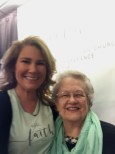
summitt beth & me.faith conf

My new best friend in Indy is Beth, and we connect because of a Christian writers group that meets at her church. So God continues to make friendships real and meaningful.

The New Year — Replacement Value

2018-2019

As I’ve closed out one year and opened another I mentally go back and forth, looking over the year past and anticipating the new year. It’s like finishing up a package of a product when I have a replacement on hand. As long as there is no new package I make the present one last longer. When a replace­ment is available I’m ready to finish the old and get into the new, knowing it’s not the end of the product. I don’t have to be stingy; I have more.

I realize my days are numbered with no promise of another day, much less another year. But I plan each day on assump­tions of time and grace available for the future, whatever allotment that may be. Now that the new year has begun and I’ve used up the old year, I’m ready (really?) for what happens in the new year, to make the best use of it for Godʼs glory.

As I look back it’s been a good year, with joys and disappointments, lessons learned and re-learned, accomplishments and failures, goodbyes and welcomes, even with sins revealed and forgiven, many a glaring ‟ought toˮ and not as many a promised ‟next time.ˮ I’ve seen others in new light – my husband’s thankful spirit oft expressed; my family’s love and tolerance for parents, siblings and children; my friendsʼ encouragement through some rough times and acceptance when I’m in the wrong; the change in church due to our move.

I see new challenges ahead for the coming year – for myself and our family. I pray that I keep my focus on the eternal and my priorities well-balanced. Goals must be suited to time and abili­ties.

Personal commitments and goals will only be realized as I seek to walk each day with Jesus, redeeming the time, wisely using a schedule for tasks, making myself accountable to God and others. Family and other commitments could get reshuffled according to othersʼ schedules, but I can keep my priorities in line and adjust to others’ needs. ‟Being availableˮ remains my job description as I allow God to order my days, even if that simply means to stop what I’m doing to prepare lunch when Bill is ready.

Calvin and Hobbes, Bill Watterson’s comic characters, reflected once on the new year. Hobbes asked Calvin, ‟Are you making any resolutions for the new year?ˮ To which Calvin responded, ‟Yeah, I’m resolving just to wing it and see what happens.ˮ Hobbes replied with sarcasm, ‟So you’re staying the course?ˮ Calvin concluded, ‟I stick to my strengths.ˮ Yes, resolutions will turn into accomplishments when I stick to my strengths.

Christmas Future

Christ.Life

Will we celebrate Christmas in heaven? Why not? Isn’t heaven the best place to celebrate Christ? For as a tiny human, He entered our world. Now He reigns in heaven.

I asked this question at the dinner table, and the response went to the name of Christ that we mention most at Christmas time: Immanuel, God with us. In heaven we will be in God’s presence; we will know Him as He knows us. On earth, God is with us. In heaven, we will be with God forever. Would that not prescribe our praise to Him for all He has done? He came to earth as the most vulnerable of all creatures, a tiny human baby, a zygote beginning in His mother’s womb. He lived and walked this planet with His disciples: healing, teaching, loving, and finally sacrificing His life for us all. Then He rose from the grave, triumphant in glory as He returned to be with the Father.

I’ve read someplace that Christ in heaven is still incarnate, still in the flesh. We will see Him. We will walk and talk with Him. He is and will be our Friend forever. I think Scripture supports this. Consider these verses in Revelation:

‟Look! He is coming with the clouds, and every eye will see Him, including those who pierced Him. And all the families of the earth will mourn over Him. This is certain. Amen” (1:7).

‟Don’t be afraid! I am the First and the Last, the Living One. I was dead, but look—I am alive forever and ever” (1:17b, 18a).

‟Then I saw heaven opened, and there was a white horse. Its rider is called Faithful and True . . . He wore a robe stained with blood, and His name is the Word of God” (19:11, 13).

‟Look! God’s dwelling is with humanity, and He will live with them. They will be His people, and God Himself will be with them and be their God” (21:3).

Christmas Present

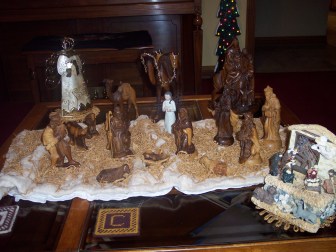
Xmas2017.Nativity.v1

Christmas is definitely different now from my time as a child and when Bill and I had our children at home, even from when our adult children came to visit with their children. As the grandchildren grew in number and age, Bill told our children that they needed to form traditions of their own and not have to spend the holidays with us every year. We loved having them visit, but their own family time was important. That changed over the years, for some came for a day or even every other year, alternating with Thanksgiving. For a while we exchanged gifts. Then because we lived away from our kids and grandkids, not knowing their sizes and interests, we would send money. Now that our grandkids are all adults and we have a dozen great-grandkids, the checks go only to the greats. They all seem to understand.

Some of our traditions have lasted with the change of times spent together. We still like to sing Christmas carols around the piano, drink eggnog (out of pink Hebron glasses) and eat cookies. Because our churches have added Christmas Eve services, that has changed our timing. We still like the habit of making omelets on Christmas morning. I make Christmas cards, recycling old cards. And as to gift-giving, Bill and I would agree not to buy for each other, but he or I would break that promise. I remember one Christmas morning Bill and I sat on our front porch, sang a carol or two, read the Christmas story from the Bible, and prayed. Back in the house we took a photo in front of our decorated tree (“nearly natural Ficus tree”).

Last year we had our first Christmas in Indianapolis with the Gearhart family. Their traditions included filled stocking hung by the fireplace, exchanging gifts, taking turns opening those gifts, and having a delicious breakfast together. The Gearhart boys were home last year with their wives. Chrissa and Léo visited his family in Brazil. This year the boys spend Christmas with their wives’ families. We will have our celebration Saturday evening, opening gifts and eating appetizers and sweets. Becky is the gift-giver extraordinaire. She knows whose names we drew, supplies gift ideas, and even orders gifts for us to wrap. We will attend the family-style Christmas Eve service at the church. Becky & Paul, Chrissa & Léo will travel to Illinois to be with Paul’s mother for Christmas Day. Bill and I are “home alone,” but we like each other enough to enjoy that time together.

Christmas Past II

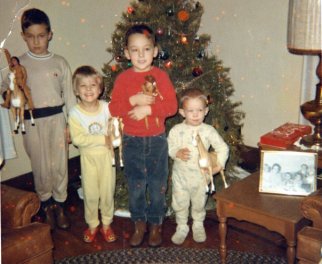
Four Coker Kids.Christmas

To have enough money to buy Christmas gifts for our family, Bill would accept a preaching engagement in late November or early December. Even with that, our gifts were not elaborate. In this accompanying photo the kids (LtoR: Billy, Becky, John, Tommy) are holding plastic horses with cowboy and Indian. Another photo would show one of them holding the rubber Gumby toy figure. I recall such toys as Mr. Potato Head, Matchbox cars, baking sets, wood-burning tools, and the popular-at-the-time board games.

When we lived in Mississippi and had only one small child, we traveled to New Orleans for Christmas Eve to be with the Cokers, and then to Mobile for Christmas Day to visit the Lairds. Later we made the long trip from Kentucky to visit family over the holidays, but not every year.

As the kids got older we developed such traditions on Christmas Eve as drinking eggnog and eating cookies after we sang carols around the piano. “We Three Kings” is the one carol most remembered, for each son sang a stanza. Then Bill would read the Christmas story from the Bible. Later we found a neat rendition of the story by Walter Wangerin, Jr. that Bill used for Christmas Eve service at church.

The kids recall that they could not go downstairs on Christmas morning before their parents were awake and ready. That took patience on everyone’s part. I’ve learned that some would peak at presents very early, but at least one did not prefer to do that. They did not like it when Christmas would fall on a Sunday, for that meant we not only went to church, but would not open presents until we returned home.

Breakfast also had a tradition: omelets made by Bill, taking orders for how many eggs and what to include.  Some years I had baked a sweet crown roll (monkey bread). The traditional Christmas dinner included turkey and cornbread dressing. But the favorite “leftover” has become the turkey gumbo we make later that week. All in all, Christmases Past provide good memories.

Christmas Past

Foursome - horiz - Copy

Christmas for me as a child and teen centered around family and church, not much different than now. I believed in Santa Clause, but I also knew and understood the true meaning of Christmas found in the birth of Christ, Immanuel, the Son of God born of a virgin. This was not, even as a youngster, a hard truth to comprehend. If God be God, then He can do anything. It’s not difficult.

Presents at our home – for three siblings: Minnie, Martha, Tommy, all younger than me – we did not find in shiny wrappings under the tree on Christmas morning. Each of us kids had an assigned place in the living room – a chair or loveseat – and so we saw the gifts all at once, no unwrapping needed. Toys mostly as a child, then clothes and such as a teen. We played with the toys or games, and some clothes we tried on that day in our rooms.

As a purchasing agent for a steamship corporation, Dad received gifts from various companies and he displayed them on top of our baby-grand piano. One special treat was a big basket of fruit (including kumquats) and nuts. I have a knife set from those gifts.

Food for Christmas day consisted of a good hot breakfast and later a turkey with cornbread dressing, rice and gravy, cranberry sauce (the jelled kind from a can), a vegetable usually green beans or corn (also from a can). Dessert came later, a cake as I remember, and always ice-cream.

Daddy would have searched in the newspaper for a church that held a Christmas morning service. It was optional for us kids, but Minnie and I found it quite a treat to go with Dad. One church downtown had a full choir in robes and Christmas decorations.

One night before Christmas day we would ride around town looking at houses that had outdoor lighted decorations. Their practice was not a tradition for our house. We did have a tree, usually a cut spruce from a lot in town. But I remember at least one year we persuaded Dad to purchase a silver- or blue-sprayed tree. Our simple decorations included lights, ornaments, and silver tinsel we placed, not threw, onto the tree.

After dinner on Christmas day we would visit family members in town or they visited us. This took up most of the day. No exchange of gifts, maybe eating cookies, spreading love and appreciation. We liked to show off our gifts from Santa or our parents. Then it was time for bed.

Three Friends

Clock

Within the past ten days we have lost three friends. Lost is not the best word, and we’re often prone not to use the word died, but passed doesn’t seem right either. Church emails report about those who have gone on to glory or who have joined their loved ones in heaven. I prefer the word used by John Bunyan in The Pilgrim’s Progress when he recorded the death of Faithful. He was transported.

On the same Sunday two of our friends, Barbara Wright and Bob Kumpf, were transported from earth to heaven. Barbara had been in the hospital and rehab for a long time, but when we saw her last summer it was a joy to see her smiling face and how she actively enjoyed her company. Her husband visited her almost daily. So while it was no surprise to learn of her death, it meant the end of our relationship with her on earth. She hosted many a great meal at their home so that her husband could do what he loved best – converse with friends. Bob’s death was a surprise, for we didn’t know of any illness. A friend reported to us his passing and also the beautiful memorial service. Bob, active with Emmaus, also had a mission and pastoral heart. He loved family and friends.

A little over a week later my special friend Sheila Oliver died after a long bout with cancer. She never complained, but her suffering and pain are no more. I say she was special, because we had a relationship built on trust. She liked to phone and talk about family and church. When I was the editor of the WGC newsletter, Sheila was my proofer. She did not want me to publish that, for fear that she might miss something, especially a name. Now the truth is out.

We will miss our friends, but grateful for how our relationships developed over the years. We pray for their family and rejoice in our Lord’s promise of eternal life. We can only imagine their transport and joy to be with their Savior and Lord.

Generations

100_1950   No automatic alt text available.  2nd sons 3

Can you see those little dots on the underside of this plant? That means there will be another generation. Photo in the middle is of four generations: my mother Minnie Burge Laird, me, daughter Becky, and granddaughter Chrissa. Photo was taken in Gulf Shores, AL, at a family reunion many moons ago. Photo on right is of four Cokers, all ‟second sons” (R to L): Bill, John, Eric, and Henry. This photo was taken at an Indy park for our 60th wedding anniversary in August 2017.

Birth order varies in the two family photos. My mother was the youngest in her family of six; I am the oldest of four; Becky is our third of four children, and Chrissa is the oldest of three. Bill is the third of four siblings; our son John is the second of four as is Eric and his son Henry.

I found this as a promo for The Birth Order Book by Dr. Kevin Leman:

Birth Order: ‟Find out what it means to you, your relationships, and your career. Do you realize that of the first 23 astronauts in space, 21 were firstborns and the other two were the only child in their family? Are you aware that many successful entrepreneurs are middle children? Is it any surprise that most comedians are the youngest child in their family? It’s all about birth order. Birth order powerfully influences who you are, whom you marry, the job you choose, and the kind of parent you are. Dr. Leman’s The Birth Order Book will help you understand yourself, get along better with others, overcome ingrained tendencies you never thought you could get rid of, and be more successful in the workplace.”

Now take a brief survey (actual or mental) about the siblings in your own family. A second-born friend told me that her older sister is the most organized, and that she herself is a mess. I like both their personalities. Among my own siblings: the third born is the organizer, the second born is artistic, the youngest can do no wrong, and I as the oldest am trying to learn how to organize better, be more creative, and do what’s right. Of all our four children I can say each has a great work ethic and a dedication to family. Have fun figuring all this out for yourselves.

Why Me?

Several years ago while driving home from the Crisis Pregnancy Center in Terre Haute, IN, I posed the question to myself, ‟Why me?” I had seen several clients whose lives indicated poor choices that led into life-changing problems. In other words, their lives were a wreck and they saw no hope for a re-haul. The contrast of their lives and mine brought me to that question of why I’ve had it so good. My parents were Christian and active in church; I had married the best man in the world; my four pregnancies were trouble-free; I had a good home, friends, and a lifestyle of value. Why me? The only answer I came up with was the grace of God, unmerited and undeserved.

Recuperating 003

In the summer of 2010 Bill contracted Legionnaire’s Disease and stayed in the hospital for 24 days until his completely covered lungs showed improvement. He recovered with some side-effects, but God healed him. During those same days and in that same hospital, cancer took the lives of two ladies (mother and grown daughter) from our church. Why did Bill survive Legionnaire’s and those two precious ladies die? I don’t have the answer. I only know that God is sovereign and that His grace is bestowed on us all.

This morning in our Sunday school class R.C. Sproul (via video) taught a lesson on suffering. For often we ask God ‟why?” and it’s alright to do so. I told the story about my questions: Why me? Why have I had it so good? Looking back on my contribution to the discussion, I know now that it was out of place, for it did not fit into the lesson. On the subject of suffering we all are in one of three places: having experienced suffering in the past, currently suffering, or we are going to enter a period of suffering in the future.

Seasons of Life

Aging

“For different seasons in life different disciplines are appropriate” (The Imitation of Christ, p.207, Thomas À Kempis, compiled and edited by James N. Watkins, © 2015). I’ve gone through several seasons of life and find this to be true in each.

When a young wife and mother, I yearned for quiet time alone for Bible study. I found out later that I (and others in the same season) would beat ourselves up with too high expectations. While a consistent devotional life is necessary for all seasons, we tend to want what’s not reasonable for our own particular situation.

Even in mid-life I would envy my husband’s time for in-depth Bible study, but he would say it’s his job, and that I needed to develop my own patterns. So I relaxed and put in time at my own pace. Only then could I enjoy my quiet time to its full advantage. Now in retirement, I can schedule more time, but that needs also to be quality-driven.

À Kempis goes on to point out that each person has a style of spiritual exercise best suited to his or her personality and abilities. I prefer to read something dated so that I can mark progress, such as a devotional classic like My Utmost for His Highest by Oswald Chambers or Streams in the Desert by Mrs. Charles E. Cowman. But these do not replace reading the books of the Bible. I like to compare an Old Testament book with a New Testament one, such as reading Isaiah and John. Most important to my personal style is journaling. It’s a combination of reflection on Bible and devotional passages along with written prayers. But I’ve found that doesn’t suit everyone.

Prayer time is my most inconsistent habit. I’ve discovered that is true with a lot of people, but that doesn’t excuse me. The Meaning of Prayer by Harry Emerson Fosdick has been the one book on prayer that I treasure most and have read several times. Writing out my prayer requests has been helpful. Following through on resolve brings me back to consistency.

Toward the end of a year is the best time for me to decide on what book or pattern of reading I will process in the new year. How about you? What new resolve or practice is on your agenda?