Christmas Present

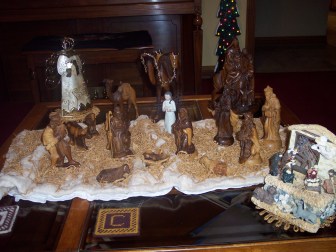
Xmas2017.Nativity.v1

Christmas is definitely different now from my time as a child and when Bill and I had our children at home, even from when our adult children came to visit with their children. As the grandchildren grew in number and age, Bill told our children that they needed to form traditions of their own and not have to spend the holidays with us every year. We loved having them visit, but their own family time was important. That changed over the years, for some came for a day or even every other year, alternating with Thanksgiving. For a while we exchanged gifts. Then because we lived away from our kids and grandkids, not knowing their sizes and interests, we would send money. Now that our grandkids are all adults and we have a dozen great-grandkids, the checks go only to the greats. They all seem to understand.

Some of our traditions have lasted with the change of times spent together. We still like to sing Christmas carols around the piano, drink eggnog (out of pink Hebron glasses) and eat cookies. Because our churches have added Christmas Eve services, that has changed our timing. We still like the habit of making omelets on Christmas morning. I make Christmas cards, recycling old cards. And as to gift-giving, Bill and I would agree not to buy for each other, but he or I would break that promise. I remember one Christmas morning Bill and I sat on our front porch, sang a carol or two, read the Christmas story from the Bible, and prayed. Back in the house we took a photo in front of our decorated tree (“nearly natural Ficus tree”).

Last year we had our first Christmas in Indianapolis with the Gearhart family. Their traditions included filled stocking hung by the fireplace, exchanging gifts, taking turns opening those gifts, and having a delicious breakfast together. The Gearhart boys were home last year with their wives. Chrissa and Léo visited his family in Brazil. This year the boys spend Christmas with their wives’ families. We will have our celebration Saturday evening, opening gifts and eating appetizers and sweets. Becky is the gift-giver extraordinaire. She knows whose names we drew, supplies gift ideas, and even orders gifts for us to wrap. We will attend the family-style Christmas Eve service at the church. Becky & Paul, Chrissa & Léo will travel to Illinois to be with Paul’s mother for Christmas Day. Bill and I are “home alone,” but we like each other enough to enjoy that time together.
Christmas Past II

Four Coker Kids.Christmas

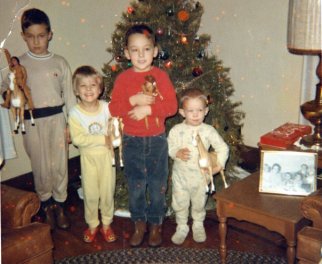
To have enough money to buy Christmas gifts for our family, Bill would accept a preaching engagement in late November or early December. Even with that, our gifts were not elaborate. In this accompanying photo the kids (LtoR: Billy, Becky, John, Tommy) are holding plastic horses with cowboy and Indian. Another photo would show one of them holding the rubber Gumby toy figure. I recall such toys as Mr. Potato Head, Matchbox cars, baking sets, wood-burning tools, and the popular-at-the-time board games.

When we lived in Mississippi and had only one small child, we traveled to New Orleans for Christmas Eve to be with the Cokers, and then to Mobile for Christmas Day to visit the Lairds. Later we made the long trip from Kentucky to visit family over the holidays, but not every year.

As the kids got older we developed such traditions on Christmas Eve as drinking eggnog and eating cookies after we sang carols around the piano. “We Three Kings” is the one carol most remembered, for each son sang a stanza. Then Bill would read the Christmas story from the Bible. Later we found a neat rendition of the story by Walter Wangerin, Jr. that Bill used for Christmas Eve service at church.

The kids recall that they could not go downstairs on Christmas morning before their parents were awake and ready. That took patience on everyone’s part. I’ve learned that some would peak at presents very early, but at least one did not prefer to do that. They did not like it when Christmas would fall on a Sunday, for that meant we not only went to church, but would not open presents until we returned home.

Breakfast also had a tradition: omelets made by Bill, taking orders for how many eggs and what to include.  Some years I had baked a sweet crown roll (monkey bread). The traditional Christmas dinner included turkey and cornbread dressing. But the favorite “leftover” has become the turkey gumbo we make later that week. All in all, Christmases Past provide good memories.

Christmas Past

Foursome - horiz - Copy

Christmas for me as a child and teen centered around family and church, not much different than now. I believed in Santa Clause, but I also knew and understood the true meaning of Christmas found in the birth of Christ, Immanuel, the Son of God born of a virgin. This was not, even as a youngster, a hard truth to comprehend. If God be God, then He can do anything. It’s not difficult.

Presents at our home – for three siblings: Minnie, Martha, Tommy, all younger than me – we did not find in shiny wrappings under the tree on Christmas morning. Each of us kids had an assigned place in the living room – a chair or loveseat – and so we saw the gifts all at once, no unwrapping needed. Toys mostly as a child, then clothes and such as a teen. We played with the toys or games, and some clothes we tried on that day in our rooms.

As a purchasing agent for a steamship corporation, Dad received gifts from various companies and he displayed them on top of our baby-grand piano. One special treat was a big basket of fruit (including kumquats) and nuts. I have a knife set from those gifts.

Food for Christmas day consisted of a good hot breakfast and later a turkey with cornbread dressing, rice and gravy, cranberry sauce (the jelled kind from a can), a vegetable usually green beans or corn (also from a can). Dessert came later, a cake as I remember, and always ice-cream.

Daddy would have searched in the newspaper for a church that held a Christmas morning service. It was optional for us kids, but Minnie and I found it quite a treat to go with Dad. One church downtown had a full choir in robes and Christmas decorations.

One night before Christmas day we would ride around town looking at houses that had outdoor lighted decorations. Their practice was not a tradition for our house. We did have a tree, usually a cut spruce from a lot in town. But I remember at least one year we persuaded Dad to purchase a silver- or blue-sprayed tree. Our simple decorations included lights, ornaments, and silver tinsel we placed, not threw, onto the tree.

After dinner on Christmas day we would visit family members in town or they visited us. This took up most of the day. No exchange of gifts, maybe eating cookies, spreading love and appreciation. We liked to show off our gifts from Santa or our parents. Then it was time for bed.

Three Friends

Clock

Within the past ten days we have lost three friends. Lost is not the best word, and we’re often prone not to use the word died, but passed doesn’t seem right either. Church emails report about those who have gone on to glory or who have joined their loved ones in heaven. I prefer the word used by John Bunyan in The Pilgrim’s Progress when he recorded the death of Faithful. He was transported.

On the same Sunday two of our friends, Barbara Wright and Bob Kumpf, were transported from earth to heaven. Barbara had been in the hospital and rehab for a long time, but when we saw her last summer it was a joy to see her smiling face and how she actively enjoyed her company. Her husband visited her almost daily. So while it was no surprise to learn of her death, it meant the end of our relationship with her on earth. She hosted many a great meal at their home so that her husband could do what he loved best – converse with friends. Bob’s death was a surprise, for we didn’t know of any illness. A friend reported to us his passing and also the beautiful memorial service. Bob, active with Emmaus, also had a mission and pastoral heart. He loved family and friends.

A little over a week later my special friend Sheila Oliver died after a long bout with cancer. She never complained, but her suffering and pain are no more. I say she was special, because we had a relationship built on trust. She liked to phone and talk about family and church. When I was the editor of the WGC newsletter, Sheila was my proofer. She did not want me to publish that, for fear that she might miss something, especially a name. Now the truth is out.

We will miss our friends, but grateful for how our relationships developed over the years. We pray for their family and rejoice in our Lord’s promise of eternal life. We can only imagine their transport and joy to be with their Savior and Lord.

Generations

100_1950   No automatic alt text available.  2nd sons 3

Can you see those little dots on the underside of this plant? That means there will be another generation. Photo in the middle is of four generations: my mother Minnie Burge Laird, me, daughter Becky, and granddaughter Chrissa. Photo was taken in Gulf Shores, AL, at a family reunion many moons ago. Photo on right is of four Cokers, all ‟second sons” (R to L): Bill, John, Eric, and Henry. This photo was taken at an Indy park for our 60th wedding anniversary in August 2017.

Birth order varies in the two family photos. My mother was the youngest in her family of six; I am the oldest of four; Becky is our third of four children, and Chrissa is the oldest of three. Bill is the third of four siblings; our son John is the second of four as is Eric and his son Henry.

I found this as a promo for The Birth Order Book by Dr. Kevin Leman:

Birth Order: ‟Find out what it means to you, your relationships, and your career. Do you realize that of the first 23 astronauts in space, 21 were firstborns and the other two were the only child in their family? Are you aware that many successful entrepreneurs are middle children? Is it any surprise that most comedians are the youngest child in their family? It’s all about birth order. Birth order powerfully influences who you are, whom you marry, the job you choose, and the kind of parent you are. Dr. Leman’s The Birth Order Book will help you understand yourself, get along better with others, overcome ingrained tendencies you never thought you could get rid of, and be more successful in the workplace.”

Now take a brief survey (actual or mental) about the siblings in your own family. A second-born friend told me that her older sister is the most organized, and that she herself is a mess. I like both their personalities. Among my own siblings: the third born is the organizer, the second born is artistic, the youngest can do no wrong, and I as the oldest am trying to learn how to organize better, be more creative, and do what’s right. Of all our four children I can say each has a great work ethic and a dedication to family. Have fun figuring all this out for yourselves.

Why Me?

Several years ago while driving home from the Crisis Pregnancy Center in Terre Haute, IN, I posed the question to myself, ‟Why me?” I had seen several clients whose lives indicated poor choices that led into life-changing problems. In other words, their lives were a wreck and they saw no hope for a re-haul. The contrast of their lives and mine brought me to that question of why I’ve had it so good. My parents were Christian and active in church; I had married the best man in the world; my four pregnancies were trouble-free; I had a good home, friends, and a lifestyle of value. Why me? The only answer I came up with was the grace of God, unmerited and undeserved.

Recuperating 003

In the summer of 2010 Bill contracted Legionnaire’s Disease and stayed in the hospital for 24 days until his completely covered lungs showed improvement. He recovered with some side-effects, but God healed him. During those same days and in that same hospital, cancer took the lives of two ladies (mother and grown daughter) from our church. Why did Bill survive Legionnaire’s and those two precious ladies die? I don’t have the answer. I only know that God is sovereign and that His grace is bestowed on us all.

This morning in our Sunday school class R.C. Sproul (via video) taught a lesson on suffering. For often we ask God ‟why?” and it’s alright to do so. I told the story about my questions: Why me? Why have I had it so good? Looking back on my contribution to the discussion, I know now that it was out of place, for it did not fit into the lesson. On the subject of suffering we all are in one of three places: having experienced suffering in the past, currently suffering, or we are going to enter a period of suffering in the future.

Seasons of Life

Aging

“For different seasons in life different disciplines are appropriate” (The Imitation of Christ, p.207, Thomas À Kempis, compiled and edited by James N. Watkins, © 2015). I’ve gone through several seasons of life and find this to be true in each.

When a young wife and mother, I yearned for quiet time alone for Bible study. I found out later that I (and others in the same season) would beat ourselves up with too high expectations. While a consistent devotional life is necessary for all seasons, we tend to want what’s not reasonable for our own particular situation.

Even in mid-life I would envy my husband’s time for in-depth Bible study, but he would say it’s his job, and that I needed to develop my own patterns. So I relaxed and put in time at my own pace. Only then could I enjoy my quiet time to its full advantage. Now in retirement, I can schedule more time, but that needs also to be quality-driven.

À Kempis goes on to point out that each person has a style of spiritual exercise best suited to his or her personality and abilities. I prefer to read something dated so that I can mark progress, such as a devotional classic like My Utmost for His Highest by Oswald Chambers or Streams in the Desert by Mrs. Charles E. Cowman. But these do not replace reading the books of the Bible. I like to compare an Old Testament book with a New Testament one, such as reading Isaiah and John. Most important to my personal style is journaling. It’s a combination of reflection on Bible and devotional passages along with written prayers. But I’ve found that doesn’t suit everyone.

Prayer time is my most inconsistent habit. I’ve discovered that is true with a lot of people, but that doesn’t excuse me. The Meaning of Prayer by Harry Emerson Fosdick has been the one book on prayer that I treasure most and have read several times. Writing out my prayer requests has been helpful. Following through on resolve brings me back to consistency.

Toward the end of a year is the best time for me to decide on what book or pattern of reading I will process in the new year. How about you? What new resolve or practice is on your agenda?

Pastor Appreciation: Integrity

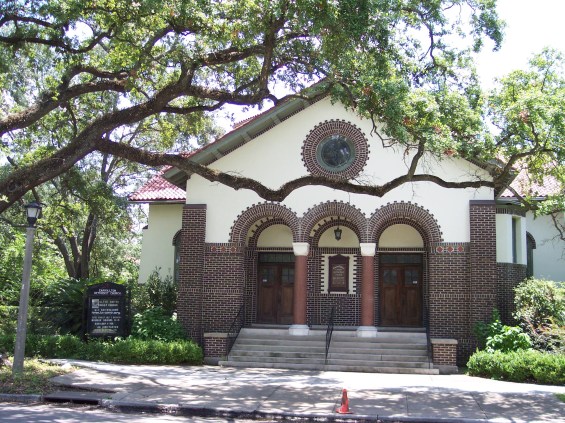
5-3-14 336Carrollton United Methodist Church, New Orleans, LA, where Bill was called to preach.

‟When we come down to it, the whole issue is a matter of integri­ty; the willingness to ask ourselves the really hard questions and seek to answer them with a total commitment to the truth.  Without integrity, everything else is cheapened, even the truth which we may be seeking to espouse. If Jesus taught His disciples anything, He taught them that He was THE TRUTH; that they would know the truth, and the truth would make them free; and that they would proclaim the truth to a world that was in the darkness of untruth.” That’s my husband/pastor’s writing. For me, Bill embodies the valuable quality of integrity.

In this month of October, the church and probably Hallmark promote pastor appreciation. For most of my adult life, Bill was both husband and pastor to me. And I’ve been blessed with both relationships wrapped into one.

I hope that you can say with me in regard to your pastors: ‟You are full of goodness, filled with all knowledge, and able to instruct one another” (Romans 15:14), ‟serving as a priest of God’s good news” (v. 16). ‟Therefore I rejoice over you” (16:19b).

In 2008 Bill retired from World Gospel Church as senior pastor and then began a few years as volunteer associate pastor at Free Life Community Church. Both churches are in Terre Haute, IN. Now we attend Southport Presbyterian Church, Indianapolis, IN, and we’re grateful for Pastors Rob Hock and Glen Massey who preach the Truth. At the beginning of Pastor Rob’s messages he says, ‟Before we go to the Word of the Lord, let’s pray to the Lord of the Word.”

Bill’s sermons always included teaching and were always founded on the Truth of God’s Word. His delivery only matched his message in presenting the Truth. To all these men of truth, I send my appreciation for your messages and your lives. I have been/am blessed.

Pastoral Prayers

WGC.artist's view

During his 19 years as senior pastor of World Gospel Church, Terre Haute, Indiana, Pastor Bill Coker led the congregation in prayer during the Sunday morning worship service. After he had already prepared his sermon during the week, he moved his attention to the pastoral prayer.

Bill’s preparation of the prayer was as important to him as offering it. He set the time apart for preparation – to be in tune with the Lord and the congregation. The writing happened on Sunday morning at the church, before anyone arrived, alone with God and thoughtful of his responsibility as shepherd of the flock God gave him.

While I cannot write adequately about Bill’s preparations for his public pastoral prayers, I was in the congregation and heard those prayers for almost 20 years. He kept those typed prayers in 7″ x 9″ three-ring binders. I read them now, and they still have a current quality, alive and fresh.

In the worship service Bill’s prayers took about five minutes, perhaps a little less for bidding prayers. His pastoral prayer would come in the early order of the service after the praise team or choir led the congregation in singing. Often the opening part of the prayer would include praise and thanksgiving, referring to the preceding worship of  music, perhaps adding a line from a hymn. The bulk of the prayer focused on the needs of the people — church, community, nation, world.

These pastoral prayers were addressed toward our heavenly Father. Not meant to bring any recognition to the author, the prayers only brought glory to the Trinity—God the Father, His Son Jesus Christ, and the Holy Spirit. Together we lifted our praise and thanksgiving to God and joined in requests and concerns related to the community of believers.

Perhaps pastoral prayers are a lost art today. What do you think?

Pointed

Sharpening a pencil to a fine point, I began to write, thankful for such a basic tool. I use a pencil to work crossword puzzles, for I’m not confident enough using a pen (like my daughter when she works Sudoku). I apply the pencil’s eraser for mistakes before looking up answers. In this one devise, a pencil, I can write and delete.

Applying this to life, I know God’s grace both when He gives strength for good deeds and His forgiveness for those mistakes (sins) I want erased. The eraser gets that point across, for we all need to rid our lives of sin and errors.

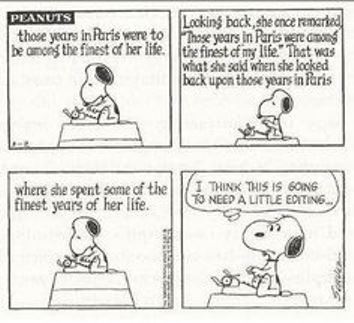
On a lesser scale but using tech devices, I type out a devotional or magazine article and the words appear on the computer screen. The editing process comes next, and with the delete button, along with cut, copy and paste, I can make the first draft more acceptable for submission to a publisher. It’s a technical improvement on a pencil with its lead point and eraser.

Snoopy.Editing

So this led me to pay attention to other uses of “point.” Our granddaughter, when complimenting her husband’s homemade dinner, wrote that the meal was “on point.” It was good!

After watching a movie one night Bill asked, “What was the point?” He did not understand (or agree with) the basic message behind the script. Our church’s missionary to Muslims in London relayed the time when he delivered his first sermon years earlier. The youth pastor had approached him and said that his exposition of the Scripture was great, but “You didn’t make a point.” In other words, the application was missing.

On Google I searched for the phrase “breaking point,” for I had heard a sports announcer say it. Along the side of the meaning, Google posted a song, “Breaking Point,” sung by Keri Hilson. That led me in a different direction – abused women who had reached their breaking point.

So what’s my point? I’m only reflecting on a word and phrase, making myself think more. This is, by the way, something I’ve learned that grade-school students these days don’t know how to do – think on their own. Think about this and make your own point.