Our Daughter’s Perspective

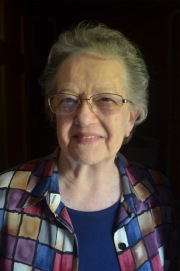
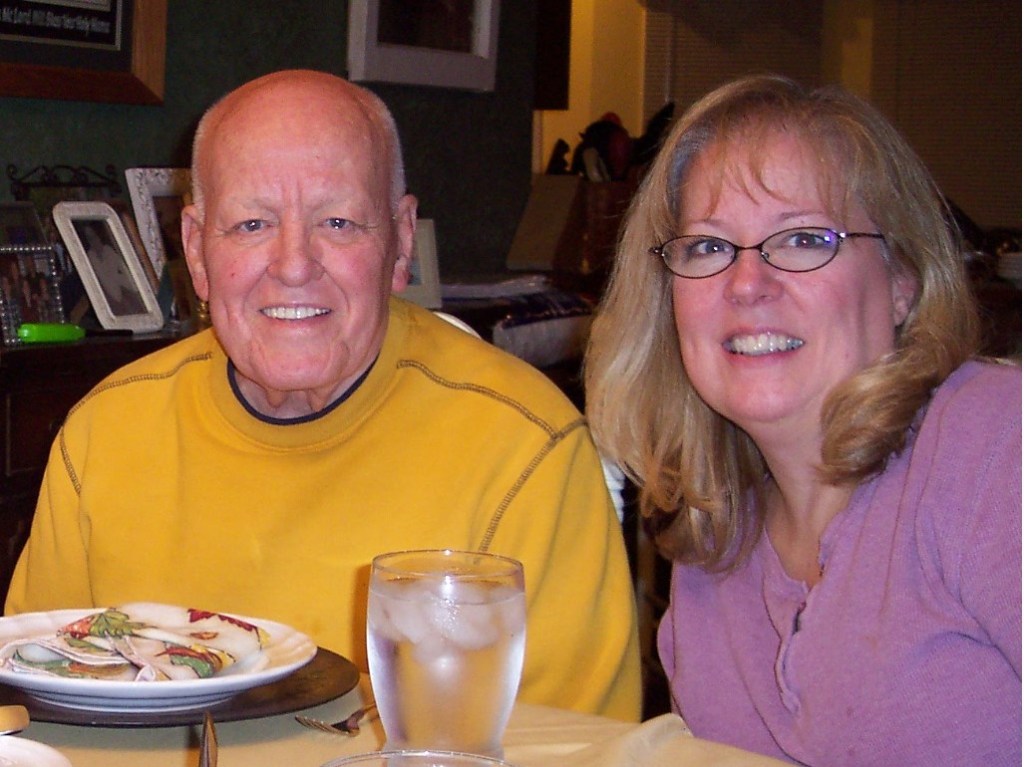
Photo taken before moving to Indianapolis. Written by Becky in June of 2023.

My mother phoned, stating she and Dad decided to move to Indianapolis and wanted to purchase a house with my husband, Paul, and me. For two years we had discussed different options, knowing my mom would need help caring for my dad. Suddenly we put preparations in motion, including the sale of both of our houses. The search began and we found a home here that would meet our needs.

No one can fully prepare you for all the nuances of caring for a loved one with dementia or Alzheimer’s disease. We read several books to understand the disease process and to know better what to expect. Several well-meaning people told me we would not be able to keep my dad in our home for the entire process. We determined to try to keep Dad at home with us. Everyone’s circumstances are different, and this isn’t always possible.

Although we experienced difficult times––watching my dad slowly slip away into the recesses of his mind––we could give thanks for much. I am thankful for the home we found that provided a secure place for my dad and where everyone had space of their own. I am thankful my dad remained happy most of the time, and he never became so violent we could not care for him in our home. I am thankful for the support of my husband, and of my brothers who made it a priority to help, including staying at the house when Paul and I traveled. I’m thankful for friends and family who prayed for us, advised us, loved on us, and took this journey alongside us.

Jay Allen wrote the song, Blank Stares, about his mother going through early-onset Alzheimer’s disease. With his permission, I quote some of the lyrics:

“It’s getting harder and harder to watch you disappear

Oh if only farther leaving me in tears

If I could only seal the cracks you’re slipping through

Wish I didn’t feel so helpless when it comes to helping you

Hold on

But I keep holding on

Every little memory made of you and me

Every little glimpse of who you used to be

I know you’re still in there

Deep down somewhere I swear I still see you

I still see you

Between the blank stares”

Dementia is a long, slow, and difficult process of dying. My dad used to say that growing old is not for sissies. Caring for a loved one with dementia isn’t for sissies either. Hold on to Jesus! ~ by Rebecca Anne Coker Gearhart, RN

This will be included as the foreword in my upcoming book on caregiving.

It’s Out There

What’s out where? My Memoir’s book proposal has been emailed to an agent. Now to do research for other agents and publishers. Here is part of the Introduction to Memoir from an Honest Caregiver. Are you interested in knowing when it’s published?

Introduction

One weekday morning Bill walked into the kitchen wearing only his jockey shorts and T-shirt. This surprising scene happened two years after moving to Indianapolis and buying a house together with our daughter and her husband, Becky and Paul Gearhart. Bill held two pairs of socks in his hands and asked which ones he should wear―black or white. My immediate reaction was due to fear, for our houseguest might find my husband in his underwear. I told Bill it didn’t matter; he could decide which socks he wanted. This didn’t solve his dilemma, for he could not choose.

This episode illustrates how Alzheimer’s disease affected my husband and how I reacted on the spot. You’ll read about our journey and view the stages of dementia caregivers experience. To our family and friends, be warned. You will see Bill as different, radically changed, not how you knew him (or me).

I introduce you to my husband before dementia began to control our lives. Bill grew up in New Orleans, Louisiana, the third of four children by a Mississippi-born couple holding modest jobs. His father worked in the railroad yard and his mother held a filing job in the basement of Charity Hospital. In spite of the family’s meager income, all three sons graduated from college.

Bill stayed home to attend Tulane University, earning a BA degree with a major in philosophy and a minor in English. He graduated in 1957, also the year we got married in Mobile, Alabama, after I graduated from Murphy High School.

Four years prior, Bill, as a senior in high school, distinctly heard God’s call to preach. Upon graduation from Tulane, Bill’s Uncle Bud, a Methodist pastor, helped him secure an appointment as a supply pastor for a small church in North Biloxi, Mississippi.

I sum up Bill’s further educational history. He received a BD and ThM from Asbury Theological Seminary, Wilmore, Kentucky, in 1963 and 1965. Then at Hebrew Union College in Cincinnati, Ohio, he earned a PhD in 1973, with a major in Hebrew Linguistics. For two years Bill taught at Asbury Theological Seminary and moved to Asbury College (University) as professor of Bible and Greek until 1989 when he accepted a pastorate in Terre Haute, Indiana, at World Gospel Church (WGC).

With this background, you can compare Bill as professor and pastor with what he later became. After 19 years as pastor of WGC, Bill retired in 2008. In July of 2010 he spent 24 days in the hospital with Legionnaire’s disease. Dementia set in soon after.

While you view various stages Bill traveled through, you are also in my head as I learned about myself. This is my story––how I connected with and cared for my husband. If you are now a caregiver for a loved one or soon to see that as your role, our journeys may relate.

For me, his caregiver, the basic loss became Bill as he used to be, for my expectations from him no longer held reality. Add my independence and control, along with loss of connections with family and friends.

Every good skit, play, story, or book needs a beginning, middle, and ending. It began after Bill’s hospital stay with Legionnaire’s disease. Writing in my journals about the messy middle of five years, I did not know how or when this memoir would close. The process of the ending was brief. The end came on the seventh of March 2024 when Bill, after two weeks of in-home hospice care, breathed his last. A new chapter began with my grief journey, but I’ve know God’s peace.

Memoir from an Honest Caregiver

Bill giving one of his serious talks (August 2023)

Each skit, play, and book needs a beginning, middle, and end. That’s how I divide my memoir about caregiving. These divisions were not equal in length. The early stage of Bill’s dementia was about five years. The messy middle, the longest stage, started before we left Terre Haute and moved to Indianapolis, lasting about seven years. The advanced stage amounted to less than a year with in-home hospice care for only two weeks.

I’ve finished listening to a computer voice read my memoir of a little over 50,000 words. That way I could hear and see mistakes needing correction. To let you engage in my memoir, understand that it’s about me as caregiver as well as about Bill and dementia. Below are a few paragraphs from each stage: early, moderate, and advanced.

We notice the first sign of dementia involves word associations. “Thing” becomes the word when specifics escape Bill. For example, he asks our son John to take a “thing” from the kitchen cupboard, meaning a cup for coffee.

When it’s the forgotten name of a person, Bill gets creative. Before a visit from our triplet great-grandchildren, he repeatedly asks me their names. Several times I say Ethan, Naomi, and Levi. He devises names of his own: Ike, Mike, and Mustard. The kids like and choose their names. Of course, Bill doesn’t recall who is who; he just groups them. They don’t mind.

While preaching for a friend, Bill tells about a famous revival of the past. It’s known as the “haystack revival.” Not able to think of the right words, Bill calls it a revival started on “a pile of straw.” I explain the mistake to our granddaughter, Chrissa. She replies with compassion, “Grandpa’s vast knowledge of words gives him a good substitute.”

I resolve to be more attuned to Bill’s needs, for I want to reflect in word and deed the true picture of a biblical wife. That begins at home by pleasing my husband. . . .

Our future, though uncertain, will see an increase in Bill’s dementia and my continuous learning how to handle our disagreements. A few aspects of Bill’s progress show the disease is no longer in slow motion.

For what am I thankful? Two are at the top of my list: Bill’s constant affection which includes blowing kisses and wanting hugs, and his sense of humor. I’m thankful for Bill’s kind disposition, even when I’m abrasive toward him. One good thing about memory loss: he’s quick to forget whatever offense takes place.

In a blog post I write about the term ambiguous loss. Our daughter, Becky, wrote about this on her Facebook page, saying her dad is here but not here. While Bill is present, what he used to be is now absent. In his frequent talks, we hear what’s not present anymore.

One evening Bill enters the kitchen as Paul, Becky’s husband, and I prepare supper. Bill started with his usual theme of doing what’s right and good. We could clearly understand that much as he continues to talk at length. His serious expression shows it’s important to him.

A few mornings later at two o’clock, I awake to see Bill standing by the bed and talking, again about what’s right. As I stand by his side of the bed, he points a finger at me and says, “It would be good for you to do what’s right.” At breakfast I tell Bill he preached during the night, but he gives no response. . . .

One night is a combination of not letting go of my rigid routine for Bill, his dealing with my demands, and an instant answer to prayer. We start getting ready for bed. Mistakenly I already laid out clothes for the next day. At first he wants to wear the corduroy pants, pointing his finger at me and shouting “No! This is what I want!” I kiss him. He calms down.

Next he holds his nightshirt and shoves his leg in at the neckline. My explaining it’s the wrong way does not compute. He gets it up past his belly but no further. After I leave for a minute and return, I find the nightshirt is off. He holds it, but won’t pull it over his head.

I close my eyes and briefly pray out loud. I ask God to help each of us get ready for bed, be calm, and do what is right. When I open my eyes, Bill is pulling the nightshirt over his head. Now why didn’t I pray earlier when the conversation was more heated? Yes, “the one who is patient calms a quarrel” (Proverbs 15:18). The rest of the routine goes well. One more decision: do not lay out Bill’s clothes for the next day.

If you are interested in knowing more––about my being in touch with you when my memoir will be published, send me a note via email. al2.coker@gmail.com  Thanks.