It’s Time to Make a Choice

In late December I choose which devotional book I’ll read alongside my Bible for Quiet Time each morning. I encourage you to join me in reading devotionals. To help with your selection, I’m including some of my favorites.

            As a young teen I began the habit of reading a daily devotional book. I still recall how vividly God spoke to me through those “two listeners” in God Calling. Through the years I’ve found that when placed alongside Bible reading and prayer, devotional literature is valuable to my Christian growth.

            My Utmost for His Highest by Oswald Chambers is a devotional classic. On day one the author invites the reader to make an unreserved commitment: “I am determined to be absolutely and entirely for Him and for Him alone.”

            Thumbing through the pages of Morning by Morning by C. H. Spurgeon, I remember personal events. The year I read this book we cared for my husband’s mother who was dying with cancer; our first grandchild was born; and my father died. Beyond these personal ties, I value this book because Spurgeon exalts Christ, intertwines Scripture and hymnody, and highlights creation.

            Several times I have read Streams in the Desert by Mrs. Charles E. Cowman, co-founder of Oriental Mission Society (currently One Mission Society). Because she compiled this volume during the six years she nursed her sick husband, the lessons speak to the hurting, the persecuted, the doubting. Her theme is confidence in God.

            Although I’ve read other books by E. Stanley Jones, I prize The Way to Power and Poise. His central theme is the ministry of the Holy Spirit, a relationship that produces a Spirit-controlled life.

            Hannah Whitall Smith is best known for her book The Christian’s Secret of a Happy Life. In God is Enough, editors Melvin and Hallie Dieter have compiled daily readings from nine of Smith’s books. Through the heartache and sorrow in her life, Smith affirms God’s sufficiency.

            In my view you cannot find a better resource on prayer than The Meaning of Prayer by Harry Emerson Fosdick. The chapter on “Prayer as Dominant Desire” made me examine my motives: Did I truly want what I prayed for? Or more exacting: Did I pray for what I wanted?

            A few years ago I discovered Disciplines for the Inner Life by Bob and Michael Benson, father and son. The format includes prayers, Scripture, hymns and excerpts from a broad base of Christian writers. In each week’s topic I found new truth to pierce my self-righteousness. Keeping a spiritual journal helped root the lessons.

            One year I read Each New Day by Corrie ten Boom, who tied together truths of experience and Scripture. The next year I selected Diamonds in the Dust by Joni Eareckson Tada. Through her struggles to accept her disability, she has found in Scripture many “diamonds” which have made her “rich in faith and wealthy in hope.” This past year I read Wisdom For the Way by Charles Swindoll, excerpts from his several books. Brief but powerful daily reflections.

            Not meant to be a devotional book, I must include one by Evelyn Underhill, my husband’s favorite author. While you might have to find it in a used bookstore, I recommend the volume which includes: The Fruits of the Spirit, Light of Christ, and  Abba. She has a style that touches the heartstrings with intellectual precision.

            In recent years, I’ve found current authors who have collected devotions from earlier saints. Such are: Take Time to Be Holy by Samuel Logan Brengle, edited by Bob Hostetler. Another by Hostetler: The Bard and the Bible, the Bard being Shakespeare. Two compiled by James N. Watkins: Intimacy with Christ, includes classics by Brother Lawrence, Francis of Assisi, and others; and The Imitation of Christ, devotions by Thomas A. Kempis, in today’s language. I also include one of my favorite current authors who, among her 50 books, wrote Jesus Every Day: Prayers to Awaken Your Soul.

            I’ve introduced you to some of my favorites. These you may consider when you make your choice. Look them up online to better acquaint yourself with authors and topics. Then choose for yourself a devotional guide to read on a daily basis by matching the book to your personal, present-day need. God will speak to you through His saints.

Hope for America

Top: Asbury University Revival 2023 and Bottom: Church Youth & Sponsors Serving Love Packages

My hope for America is rooted in God’s work among the youth of our nation: high schoolers, college students, young adults. I’ve noticed in recent weeks and months their commitment to follow God’s calling on their lives.

The first events were revivals on college campuses. At Asbury University, Wilmore, Kentucky, a spontaneous revival lasted several weeks and spread to other colleges across the nation. When people heard about these, they flocked to the campuses to be a part of the renewal of mind and heart. Baptisms for new believers followed.

The latest indication of God’s impact on young people came before and after the death of Charlie Kirk on September 10th of this year. This influencer connected with youth in many states, and his messages centered on what matters most: Jesus and truth. The fight continues to bring God’s truth back into our nation, communities, and churches. Turning Point USA will continue even after its founder’s death, because his wife and staff are committed to keeping the legacy growing. Jesus and the truth matter. Evil will be conquered with God’s Word.

News report from CBS on 9-5-25 — “Young people across America are searching for the truth and turning to faith in record numbers. Statistics are showing the Millennials and members of Gen Z are increasingly flocking toward faith. CBN News recently talked with politicians and faith leaders about this trend at the Kennedy Center premiere of … the new film ‘The Revival Generation.’”

Throughout our land, youth are coming on board to fight for truth. They either verbally say or put on t-shirts: “I am Charlie Kirk.” Also in the church I attend, young people unite to spread the good news of Christ and His Word found in the Bible. It’s happening where they work and play. As one student said, “Negative action doesn’t require negative reaction.” And a kindergarten teacher working with needy students reported that God has placed her there for a reason. That assurance keeps her from being discouraged.

I am encouraged about the future of America. A global impact is happening as young people stay committed to truth and follow God’s leading. This speaks loudly to me as well, for even at my age of 86, I am not finished. I still have a job to do––to speak out against wrong and for the right. I started by adopting a simple practice from Charlie Kirk: I’m turning off my phone (no social media) on Sundays. This matters because Jesus is what matters most. Join me in this fight.

Growing Old and Reputation by Bill Coker

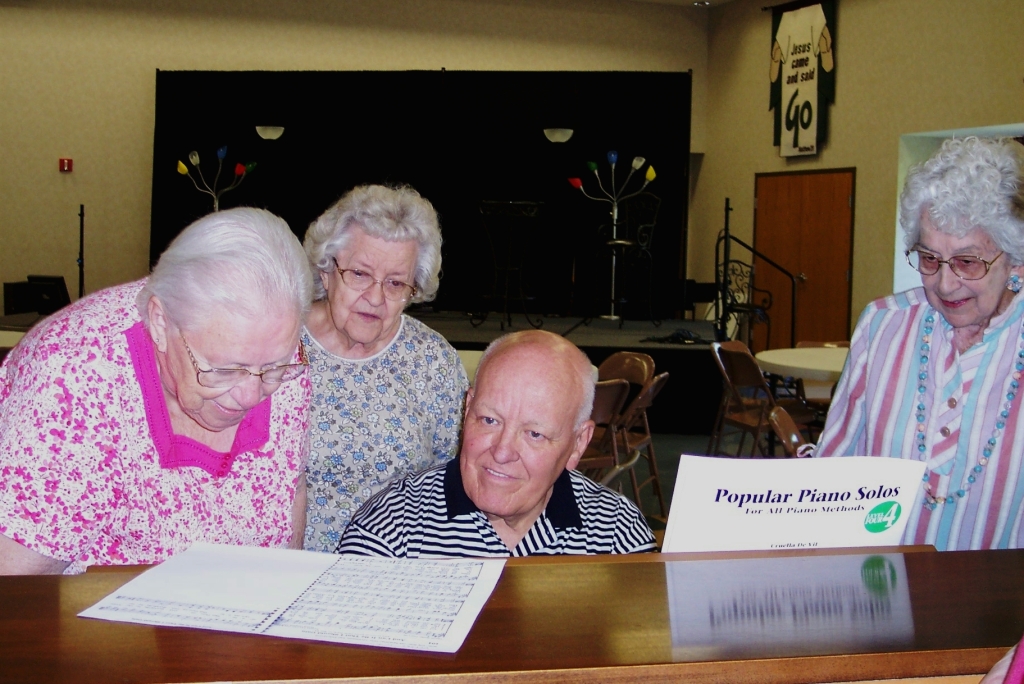
Some stayed to sing together after a Senior luncheon at WGC.

From Bill’s 2002 journal when pastoring World Gospel Church, Terre Haute, IN:

“As I reflect on my own pilgrimage, I am overjoyed to see God shaping my life in ways that I had longed for and now am pleased to recognize. I continue to wrestle with my personal particularities but am more and more understanding and accepting those preferences and peculiarities that mark out my self. Where I am pleasing God, He must inform and convict, and the Holy Spirit work, as Jesus promised.

“My desire is to please God, walk in His will, and glorify His Name. I have dreamed of building His Temple, but like David, must accept a different role––not judging myself a failure but willingly and gladly being the best at what I am.

“I always thought that growing old would be great, for wisdom would only come by experience. While I look back on many regrets, see my numerous faults and failings, am ashamed of my sins, and could only wish that I had been better disciplined, I must say that ‘my lines have fallen in pleasant places,’ and God has been especially gracious.

“‛Never seek a reputation for being learned’ (a Kempis). Our quest is for truth, and ultimately, to know God––or as Paul wrote, ‘rather, to be known by Him.’ Paul’s testimony to the Philippians comes quickly to mind: ‘I count all things to be loss in view of the surpassing value of knowing Christ Jesus my Lord…that I may gain Christ…that I may know Him and the power of His resurrection and the fellowship of His sufferings…’ (3:8–10, NASB).

“How much, how often, have I cared about my reputation––as though it ever mattered or was worth the cost of gaining or protecting it…. In spite of my efforts to ‘die to self,” I am still very much alive. Now I have no need for reputation, but the desire for it arises time and again to remind me of an enemy not completely subdued (though I see progress over the past 13 years). The words about Mother Teresa continue to show me the better way: ‘She is willing to be nothing; therefore God can use her to do anything.’ May the Holy Spirit cleanse my heart of every desire to be known except by God.”                                                                                                                        

Not Once but Twice

Bill came home in the middle of the day as I was ironing in the dining room. He said, “I quit.” Startled, I asked for details. He was an adjunct professor at Asbury Theological Seminary, and we were living in seminary housing. He had asked the president for a short leave of absence in order to complete the dissertation for his PhD at Hebrew Union College. With the request denied, Bill said he could not continue teaching.

I’m not sure now how much of the school year was yet to complete, but my concern was loss of not only an income but position in the school and community. Wilmore, Kentucky, was the town of two prominent schools: seminary and college. Somehow the news traveled across the street to Asbury College, and not long afterward the president there asked Bill to come for an interview, and he was later hired.

In the meantime, I had doubts and questions about what would be next. Our four children needed a father with a substantial job. That night, as usual, we knelt on either side of our bed and prayed. I don’t recall what Bill said, but it made me feel calm and confident God would provide. I knew Bill was capable of teaching, but he also needed to finish that dissertation. As I said, Asbury College’s president hired Bill and also gave him the first quarter off (with pay) to work on his dissertation. During that time it became evident that the subject matter was not suitable, for the assigned translation had several languages not in Bill’s knowledge. A trip to Cincinnati to confer with his major professor meant a change in topic and a later proposed trip to Israel.

While the dissertation did not get completed before the next quarter’s teaching load, Bill had broken its back, so to speak. The new job at the college meant another house for us, a consistent salary, and a productive program of teaching for Bill. Before long Bill earned his PhD and became a full professor. Our whole family gained lasting friendships, and I also earned my BA at the college.

But this “quitting a job” happened again. After some changes at the college, Bill accepted a position at OMS mission agency in Greenwood, Indiana, and we moved there. Two years later, after a board meeting, Bill arrived home to announce that he resigned. Now what? The decision was reasonable, for his staff position required that he should have had field experience. He did not, and felt it illegal to continue. A seminary in Oregon offered him a position, but he turned it down. Then the unexpected: Asbury College called to request he return as academic dean. This he accepted, and we moved back to Wilmore.

This would not be the end of moves for our family, but it did confirm God’s provision and protection during changes in salary and location. We trust God, for He is good all the time.

How to Communicate Personal Faith — Bill Coker

Which Way?

“I have no choice. If I am to feed these people I must put the food on the table where they can reach it. If I don’t, they must go elsewhere. So the question is ‘Can I?’ I must. My prayer now is for the Holy Spirit to give me the wisdom I need to be simple without being empty, practical without ‘dumbing down’ the Gospel.

“The really important question is whether I can be of some value to help someone else. Can I give spiritual direction to someone and spare them from some of my struggle? What I’m seeing needs to be reflected more in preaching.

“The volume of reading and time for meditative thinking have broadened and deepened my own spiritual life and have enabled my preaching. A comment made after I previewed my talk for the forthcoming Emmaus Walk was encouraging: ‘Some speakers hold your attention with jokes; Bill does it with knowledge.’

“My task is to be a faithful servant––faithful in my obedience and courageous in my commitment. All else is in God’s hands. I will be used as He wills to use me and will accomplish what He wants to do through me. What else really matters?

“I guess I’m more concerned with what I’m trying to provide ‘the flock’ than the flock is about receiving it. I know that times have changed, but where does one draw the line and say that these things cannot be sacrificed for our ‘good times.’ Many would think my feelings about these things are unreasonable and overly protective. Maybe so. And maybe the losses the Church is sustaining should tell us we are paying a spiritual price for our materialistic pleasures. And maybe the gradual slope will end at a disastrous precipice.

“The Lord continues to show me areas where I am deficient or flawed. In some ways that brings shame that I have not gotten further in my growth; in some ways it makes me aware of personal needs that unconsciously I seek to meet; but in every way I rejoice that God is still working––clarifying, correcting, cleansing, and directing. More and more I desire to be the kind of person in whom others can see the Lord’s grace at work and through whom the Holy Spirit can speak and work and manifest Himself.

“As I reflect on my own pilgrimage, I am overjoyed to see God shaping my life in ways I had longed for and now am pleased to recognize. I continue to wrestle with my personal particularities but have become more and more understanding and accepting of those preferences and peculiarities that make up myself. Where I am not pleasing God, He must inform and correct; and the Holy Spirit’s work, as Jesus promised, is to convict.

“My desire is to please God, walk in His will, be the servant of His Word, shepherd His people, and glorify His Name. I have dreamed of building His Temple, but like David, must accept a different role––not judging myself a failure but willingly and gladly being the best at being what I am.”

This is in answer to the survey I posted. I gleaned from Bill’s 2002 journal while the pastor of World Gospel Church in Terre Haute, Indiana. AC

Take Home Test ~ WBC

Some of you will recognize Bill’s test duplicated here. It’s minus the dingbats he used. ~AC

  • Have you made a personal decision about Jesus Christ?
  • When, to your satisfaction, did you do so?
  • Has that made a definite change in your life?
  • “If anyone is in Christ, he is a new creation. The old has passed away…the new has come” (2 Cor. 5:27).
  • What do you believe?  ~ The Apostle’s Creed
  • Rational and personal conviction
  • “The love of Christ controls us because we are convinced that one has died for all….” (2 Cor. 5:14).
  • Do you have faith in God? [Consider the meaning of faith]
  • Certainty, firm reliance  ~ Confidence, Trust
  • Trust in God that holds steady in times of difficulty
  • Faith that God is at work in all things for good
  • What do you think your commitment to Christ means?
  • What does your head and your heart  say to you?
  • Does the Holy Spirit bear witness with your spirit?
  • What are your strongest spiritual desires?
  • To be with Him – public and private worship
  • To know Him – even the fellowship of His suffering
  • To please Him – greatest pleasure
  • “I want to know Christ – yes, to know the power of his resurrection and participation in his sufferings, becoming like him in his death” (Phil. 3:10, NIV).
  • What is your participation in the Body of Christ?
  • What is your contribution to the church?
  • What if everyone did as you do?
  • What is your level of concern for others?
  • How have you expressed that concern recently?
  • What about the acid test? ~ Thy will be done…?
  • Is your chief aim in life to do God’s will?
  • Do you regularly choose God’s will over your own?

Help Has Steps

Facing new decisions with caregiving, I mentally said, “I need help,” and thought of this cute photo. This child’s face could be my own expression. But now I know help in many and various ways.

“Help” moved me to think of The Pilgrim’s Progress where Pilgrim was stuck in the bog and Help, a person, came to get him out. Help asked, “But why did you not look for the Steps?” with Bunyan’s biblical reference: “When I was in great need, he saved me” (Psalm 116:6).

Pilgrim’s help was available in the steps that would rescue him from the Slough of Despond. Once out of the bog, Help bid him to continue on his way, but first Pilgrim asked why the Slough of Despond was placed along the Way. I relate this tale in my book, Journey with Bunyan’s Pilgrim, and add my takeaway:

“Pilgrim’s question is also one I might ask. Why would such a place of mud and mire be left to hinder a Christian along the way of salvation? The answer Bunyan gave by way of Help can be borne out in my own experience. . . . Asking for help hasn’t slowed down my process but instead given answers to speed me on my way.”

Why do I need Help now? Bill’s Alzheimer’s disease has moved into the advanced stage, and we need to examine Steps to make life easier for him and us as caregivers. Becky, Paul and I talked about next Steps. At first, options included: (1) Changes in furniture and equipment such as a hospital bed and wheelchair, requiring that we move current furniture; (2) Senior Care in-home personal care from a local agency; (2) Move to a memory care unit in an assisted living facility. All are good and cost factors vary. What do we do next and what benefits us best?

While researching the options, we turned to another not exactly on the original list. We have chosen Hospice in-home care, and it’s been the right decision. That means end-of-life care, an honest evaluation. In two days Bill was evaluated and signed up because of two main criteria: lack of mobility and poor communication. A hospital bed was ordered and assembled in our bedroom; a schedule of helpers arranged; and the care we needed lined up. The first day on the schedule brought to our home: RN case manager, social worker, chaplain, and an aide. Each performed suitable and needed tasks with professional skill and gentle care. Of course, I still rely on our daughter with her nursing skill and our son-in-law with his good ideas and encouragement. Many friends and family members have sent loving notes of concern and prayers. Above all, we are grateful for our Lord’s help.

Help is available, and we have followed God’s guidance for the best Steps to take.

Though None Go with Me

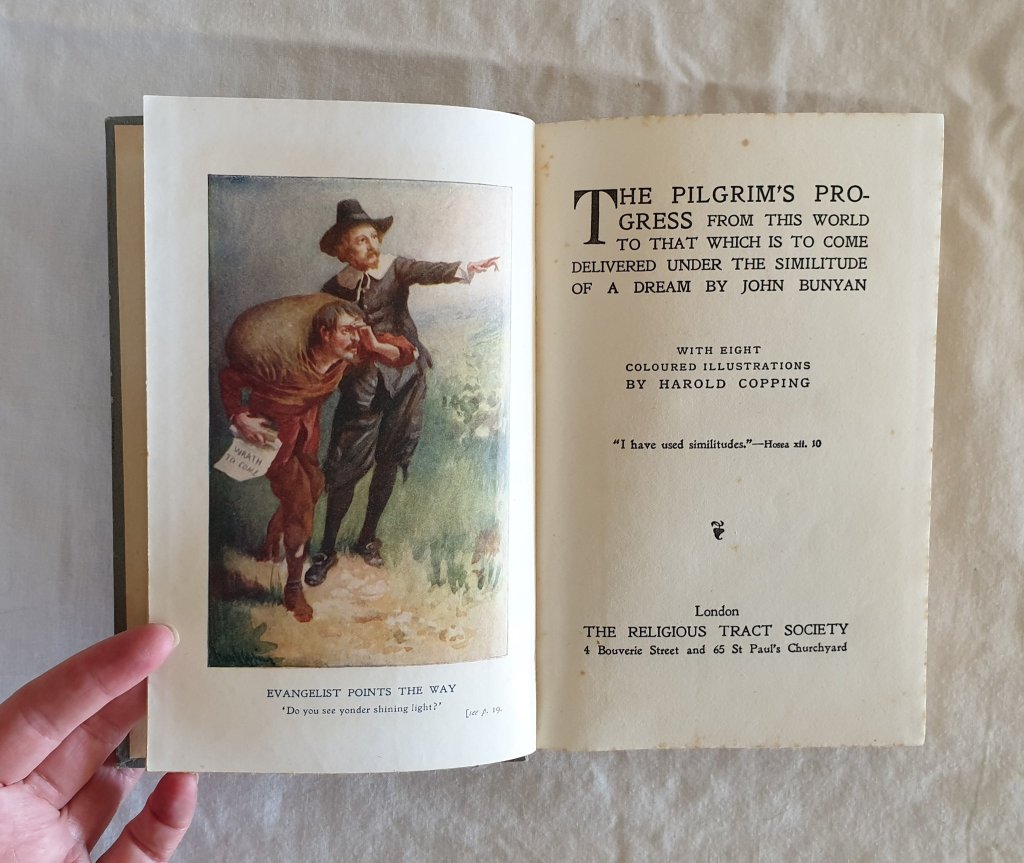
Title Page, early edition from the Religious Tract Society, London

In The Pilgrim’s Progress, John Bunyan’s Pilgrim saw the grim reality of what his decision meant to leave a city in ruins, but his main concern focused on salvation, safety now and for eternity. He decided to leave home in search of redemption, as he invited those whom he loved to go with him. When none would go with Pilgrim, it came to a parting of their ways.

“Now he had not run far from his own door, but his wife and children perceiving it, began to cry after him to return” (p. 4, Barbour edition). This scene was based on Lot’s exit from Sodom and the warning the angels gave his family.

“As soon as they [the angels] had brought them out, one of them said, ‘Flee for your lives. Don’t look back, and don’t stop anywhere in the plains’” (Genesis 19:17),

Here Bunyan also introduced the cost of discipleship. If we are not willing to leave mother and father, wife and children, any family member, we cannot follow Christ. (See Luke 14:26, 27.) This reminds me of a seminary student we met years ago.

The student served Bill and me a simple meal in his seminary apartment, but his testimony became the main course. He had come from an Asian country to Kentucky, USA, for ministerial studies, and at quite a cost. He could no longer claim family as his own, for once he declared his allegiance to Christ, his parents disowned him. In a personal way, he introduced me to the persecuted church.

Something for you to think about: Was your conversion viewed by family with joy or disdain? How did that affect your commitment?

~ excerpt from Journey with Bunyan’s Pilgrim by Ann L. Coker