
This sample day will appear in my companion book for John Bunyan’s The Pilgrim’s Progress.
Shame Can Be Good Week Two Day One
Christian ‟saw Evangelist coming to meet him; at the sight also of whom he began to blush for Shame.” . . . Evangelist ‟began to reason with Christian” (p. 15, Barbour edition; p. 22, Moody edition).
‟Come now, and let us reason together, saith the Lord” (Isaiah 1:18, KJV).
When he saw Evangelist, Christian blushed with shame. Evangelist questioned Christian who defended his departure from the prescribed way to the Wicket Gate. The advice of Worldly Wiseman seemed good at first, or at least easy. But Christian found no relief from his burden.
Evangelist’s reasoning counteracted the worldly wisdom that led Christian astray. From this experience Christian learned to hate three things: if he turns out of the Way, if the Cross seems too hard, and if someone leads him on the path of death. The emphasis remained on the Cross—to prefer that more than any treasures he could collect. All Evangelist’s teaching was saturated with Scripture from the gospels and epistles. ‟May I never boast except in the cross of our Lord Jesus Christ” (Galatians 6:14).
Christian asked if there was still hope for him. Evangelist neither ignored nor excused the pilgrim’s sin, but instead sent him on his way to the gate. Determination now ruled his steps.
Takeaway: Christian’s sorrow led to repentance. I think first of shame as something wrongful, but shame can lead to confession and redemption. If I admit my shameful acts I start the road to recovery and to right the wrong. I’m grateful for second chances, for even now as a senior citizen, I need hope for today’s failures and tomorrow’s fears.
Your Turn: What second chance has God given you by His grace? ________________________________________________________________________________________
________________________________________________________________________________________
________________________________________________________________________________________
Author: aflcoker
I love the Lord. To those I love I am wife, mother, granny, great-granny. To my corner of the world I am a writer.
Diving Deeper
Diving Deeper Into My Passion for The Pilgrim’s Progress
Yes, I have a passion for The Pilgrim’s Progress by John Bunyan. But I tend to tell about it in surface waves, so I need to dive deeper with you. Why is this passion of value? How do I feel when I read Bunyan’s classic? What are the connections that make me share this passion with you?
Take the book by itself and it could be boring, especially if read in the original script. What made it come alive to me was the combination of the book, Scripture, and personal experience. The tool that connected these ingredients is journaling. When I read a section of The Pilgrim’s Progress I also looked up the Scripture references Bunyan cited and some that came to my mind. Further connection meant I would address a personal need or happening in my life. Then I would write it down in my journal. I’ll prove this case with two examples.
 The scene around the Slough of Despond held several characters in contrast. Pliable decided to join Christian, but when he fell into the muck, he got out on the side closest to home. Only one way gets us to the desired destination and that’s keeping on the way. It’s ever a temptation to turn around and head back to what’s familiar and seemingly safe. When I’ve been interested only in the benefits and blessings of God’s way, I get tangled in myself and lose sight of what’s ahead. (See Psalm 119:105.) But a strong man, Help, rescued Christian from the slough. He pointed to the steps, always there but not noticed. He promised that help is always available when needed. Too often I try to get myself out of a problem first before turning to ask for help from Jesus. The focus is only corrected when I remember God’s Word and His steps that lead me to Him. (See 1 Samuel 12:23). In this one passage I’ve corrected my faulty way with God’s right way.
At one point in the journey, Christian met Hypocrisy and Formalist. Here was a good teaching point about faith vs. works (Galatians 2:16). I ask myself, “Do I ‘walk by the rude working of my fancies’?” I wrote in my journal about a day at the Crisis Pregnancy Center. I saw six clients and I confessed a need to be ready and bold to proclaim God’s love and deliverance, to be confirmed in peace as I help unhappy people. Then on the following Sunday, I was tempted to pity myself. No one wanted to sit by the pastor’s wife. So I took the initiative and chose to sit by someone who was also alone. Like Christian, I’ve moved up the Hill of Difficulty, stopped at the “pleasant arbor,” and found rest and renewal.
Do you feel the need to make connections and seek out your feelings as I’ve done? My hope-to-be-published book will help you with your journey. I trust you find a passion for relating your own need with the helps found in Bunyan’s classic, Scripture, and thoughtful journaling.
My Love Affair with Pilgrim
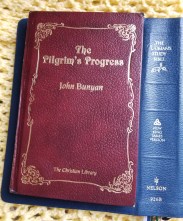
I began my love affair with John Bunyan’s The Pilgrim’s Progress when I found Barbour’s unabridged edition complete with marginal notes and Scripture references. Hearing Bill quote Bunyan in sermons piqued my interest, but reading this classic and looking up each Scripture gives substance for my Christian growth. My daily thirst for following Christ is satisfied as I discover Bunyan’s creative details of the joys and pitfalls any Christian experiences. Bunyan’s characters, the places, the journey itself all have meaning and contribute to knowing what it means to be a Christian in a world that’s not a friend to grace. Each time I return to this book I find fresh food, for it’s like reading and re-reading the Bible. I always learn more about who God is and who He wants me to be.
Do you understand the Christian life, what it means to follow Christ? I’m not alone when I answer that question with a tinge of doubt. Like me, you also need a guide during your life’s journey – to find meaning in daily struggles. Yes, we read our Bibles and we pray for God to guide us. And yes, we practice Christian fellowship with other believers. In reading The Pilgrim’s Progress along with Scripture I connect my personal life with Pilgrim’s journey to the Celestial City. Pilgrim struggles with doubt and fear, but he also seeks what’s right and good in order to please Christ his Savior. Companions who travel alongside help him trust and rise above inner struggles. These are examples for me to follow.
The format of my book, Journey with Bunyan’s Pilgrim, [yet to be published] is wrapped around the genres of Bible study and personal devotions, with the structure of a six-day week. In thirteen weeks, each day includes a reflection on a portion of Bunyan’s book, how this section connects Scripture with personal experience, and a question for the reader to answer in thoughtful journaling.
Prepare yourself for an exciting journey. As you read The Pilgrim’s Progress, you’ll encounter obstacles, snags, and people who won’t support you, but you will also have rewarding fellowship with some special travelers. Come along and journey together with my companion book (when it gets published). You’ll not regret it. This is no usual travel book.
What was Bunyan’s Purpose for Rest Stops?
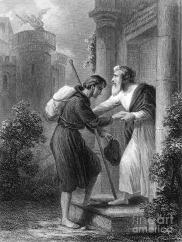
When traveling in our day as well as in Bunyan’s day, we all need rest stops. Today we identify rest stops by the nearest town or their varied features – whether they have road maps, vending machines with our favorite snacks, and clean restrooms (most important of all). We are grateful for this addition to our road travels.
The Way provided rest stops for Christian and his companions and each had a name and a purpose. While Christian had a few snags at the beginning, he arrived at his first good stop as Evangelist had directed him, and that was the Wicket Gate. Though his time there was brief, Goodwill pointed him to the Interpreter’s House even before he arrived at the Cross.
Thus Christian still had his burden of sin on his back as the Interpreter gave him a tour around the rooms filled with object lessons. The type of rest Christian received here came in the form of instruction necessary at the start of his journey. In later episodes he would make the application. For example, two children, Patience and Passion, occupied one room. Often Christian needed this lesson of patient waiting for the right answer.
At the Cross eternal rest began as the burden of sin fell off Christian’s back and rolled into the tomb, never to be seen again. “He said with a merry heart, ‘He has given me rest by His sorrows, and life by His death.’” Three heavenly beings assured Christian of peace and sins forgiven, and gave him new garments and a book to read along the way.
The next rest stop, the Palace Beautiful, is likened to the Church and fellowship of believers. The porter welcomed Christian and introduced him to the household of faith: Discretion, Prudence, Piety, and Charity. Each has a part in preparing Christian for the rest of his journey. As they questioned him about his past, his purpose, and destination, we find out that Christian’s former name was Graceless. He told them of his family, how he began his journey, and what had kept him on the way.
Toward the end of the journey, Christian and Hopeful found refreshing while at the Delectable Mountains in the care of Shepherds. From here the travelers view Immanuel’s Land. The shepherds’ names also tell of their duty: Knowledge, Experience, Watchful, and Sincere. A few more stops and the pilgrims reach home – the Celestial City.
Did Bunyan have hidden meaning for his characters?
John Bunyan’s pilgrim is named Christian who met many interesting people on his way to the Celestial City. I introduce you to a few. Some traveled with Christian, such as Faithful and Hopeful. Right there you know that names have meaning. Faithful was Christian’s first companion, but they did not meet until after Christian had been to the cross and helpful instruction invested in him. At first Faithful came reluctantly alongside Christian, but then he found benefit in their discourses and evaluating others along the way, as well as keeping to the right path that did not always look straight or smooth.
The first person Christian met was Evangelist who pointed him in the right direction and warned him of taking any shortcuts. Two men from the same hometown, the City of Destruction, chased after Christian. Obstinate set his mind to persuade Christian to return home, but Christian was determined because of two items he possessed: the Book that showed him the way and the burden of sin on his back. Pliable, the other neighbor, easily drew near to accompany Christian when he learned of upcoming rewards such as golden streets and gates of pearl. But Pliable, true to his name, soon headed back when they met unexpectedly with difficulty.
A strong man named Help got Christian out of that difficulty and set him on his way again, promising that help was always available. Christian soon met Mr. Worldly Wiseman who berated Evangelist’s direction and persuaded Christian to take another (easier) route. Yet this gave Christian false hope in the village of Morality where he would meet a man called Legality. Evangelist rescued Christian who confessed his wrong. He quickly set out for the Wicket Gate where Goodwill let him inside. From there his journey added benefits and endured hardships.
If this begins to resemble our Christian walk, you understand Bunyan’s purpose in developing this story he puts forth as a dream. Remember that Bunyan wrote this in prison. He knew hardship and the loss of fellowship. Many more characters develop the character of Christian who in the end enters the Celestial City with his friend Hopeful. We learn much more about growing as a Christian when we travel along with them.
Words of Endearment – Bill Coker
 The reason I prefer the word endearment to the word commandment is because commands are often viewed as a form of oppression or military might. As a result, we tend to think of God demanding and booming a list of rules at Moses. This creates a wrong image of God. If we look at a passage in Deuteronomy 6, God’s intention is made clear.
“And the Lord commanded us to do all these statutes, to fear [reverence] the Lord our God, for our good always, that he might preserve us alive, as we are this day” (Deuteronomy 6:24).
Moses said God’s statutes are for our good. God has given us these words not because He is sitting up on the mountain saying, “I’m God and just to remind you, I am giving you these commandments and you better obey me—or else.”
In John 3:17, Jesus said He had not come to judge the world, but to save the world. Later He said, “I came that they may have life and have it abundantly” (John 10:10).
When I look at the Decalogue, I understand what God is primarily saying to the people of Israel (and as an extension, to us): “I am giving you these words because they are the way of life. My intentions are good. If you will do these things, not only will your personal life be blessed, but society itself will be blessed.”
To know God’s blessings as individuals or as a society, God has established boundaries. Boundaries are the most freeing thing that can happen to anyone. That is why parents must realize the worst thing they could ever do to a child is never set a boundary.
A parent may say, “I am giving my child freedom.”
No, you’re not. Freedom is found within the consciousness of the real boundaries of life. When you set boundaries, you give the person an opportunity to express freedom.
Here is an easy illustration. If you are boating on the water, you find lanes to move from closed waterways to open waterways. Buoys are set as boundaries. Inside the buoys is where it’s safe to traverse, but there’s danger on the outside of these, such as rocks or shallow water that will damage or destroy the vessel.
The Decalogue is much the same. What’s amazing about these ten words is how limited they are. God doesn’t spell out every little detail. He sets the guidelines, the channel markers, the edge lines for your lane.
Here God gave His people guidelines from which they can discover life. I once heard someone aptly say that the God who gave the Israelites the Decalogue is the God who gave us Jesus. This is God who loved us and is not trying to strike us down.
He is God who loves you so much that He was willing to bear your sins to bring you back into a right relationship with Him. The God of Mount Sinai is the God of Mount Calvary. If you separate God from His Decalogue, you are doing a grave injustice, not only to the Old Testament, but to all the revelation God has made for the coming of Jesus.
— a condensed excerpt from the upcoming book: Words of Endearment: the ten commandments as a revelation of God’s love
Story Line for The Pilgrim’s Progress

John Bunyan’s book, The Pilgrim’s Progress, is an allegory. Webster defines allegory as “the expression by means of symbolic fictional figures and actions of truths or generalizations about human existence.” That’s a lot of words to say that the characters and activities have meaning. Bunyan’s meaning is not hidden, but sometimes a reader has to work for it. It’s not a true story but the story reveals truth.
The story is about a man named Christian and he’s on a journey after leaving the town of Destruction. Evangelist guides him to the Cross where the burden of his sin rolls off his back into a sealed tomb. (It’s an actual burden he’s carrying on his back.) Along the way he meets people who either help or attempt to obstruct his travel to the destination. The names of these characters reflect their inner strengths or weaknesses: Faithful and Hopeful as well as Pliable and Lord Hate-good. [I’ll tell you more about Bunyan’s characters in a later post.] Christian’s way is not easy; for while others may hinder him, he must also deal with his own faults and failings, such as pride and doubt. After a number of detours, Christian and his friend Hopeful reach the Celestial City. Soon to follow him are his wife, Christiana, and their sons (part two).
Examples of the allegory in the story line: Not far into his journey, Christian falls into the Slough of Despond. Perhaps we can relate to that situation when our determination gives way to a season of doubt. Being rescued by Help, Christian meets Mr. Worldly Wiseman who tempts him to take a shortcut by way of the city of Morality where he will be instructed by Mr. Legality. It’s the oft-repeated option (however wrong) of attempting salvation by works.
And that’s only the beginning. This thread of truth runs throughout the story and we can easily see our own story in Christian’s journey.
Who Is John Bunyan?
-
John Bunyan (1628-1688) is best known as the author of The Pilgrim’s Progress. Yes, he lived that long ago and the popularity of his book has lasted these many years. John was the son of a poor tinker, one who repairs pots and pans. He was born near Bedford, England, and his parents were quite used to “fire and brimstone” preaching on Sundays.
John had little formal education but enjoyed studying the Bible. His sins rested heavily on his mind and he sensed that God would not save such a mean boy. Even when he started preaching, he struggled with the assurance of his salvation. He remembered the sermons he heard as a youth and felt himself caught in a slough of muck and mire, on his way to hell.
Bunyan read such greats as Luther, Knox, and Cromwell and took various theologies from all for his personal stand. He wrote many pamphlets to state his beliefs and often these pointed out objections he had with such groups as the Quakers. His wife, Mary, would occasionally differ with some of his writings, yet remain faithful to his practice of truth-telling and active faith.
As Bunyan’s preaching drew many to hear him, the state-approved churches did not approve. He landed in jail and that’s where he wrote The Pilgrim’s Progress to be later published in 1678. That such a book in King James’ English has remained a classic begs questions as to why. I’ll address this in my next blog and introduce you to its writing style and popularity.
Two Lessons from Kobe’s Death — Guest Blog Post by Peter Heck
 Photo credit: Pixabay/WolfWolfWolf
I was walking back to my classroom after school last week and stopped to talk to the evening custodian. I asked him how things were going and he said, “I’m just still struggling.” I worried that maybe I was missing something that I should have known about, but he quickly came back with, “So how did Kobe affect you?”
I told him that while I was never a huge fan, Kobe was my age, and was such a great player in an era I spent my young adulthood watching that it was very strange to think about him being gone. I definitely sensed he wanted to talk about it – it almost seemed like he needed to talk about it. So we did.
As I drove home it really struck me that this guy was grieving someone he never met, someone he had only seen on television. When I told my wife about it, she said that she had overheard two ladies talking about the Bryant helicopter tragedy and they were agitated that more attention wasn’t being paid to the other people who died that day.
Two very different reactions, but having been given a week to process things, I think there are some meaningful lessons for all of us in both of them.
First, I would humbly suggest to the two ladies and everyone else who feels similarly, that mourning Kobe Bryant is not a slight, insult, or an affront to the memory of the other victims of the crash. Simply put, Bryant’s face was everywhere, his persona transcended his profession, and even those who were not fans of the NBA had Kobe at least peripherally a part of their lives.
From a logical standpoint, it makes complete sense and is totally appropriate that the unexpected, shocking death of such an individual would leave people shaken, sad, and suffering some form of grief. The same kind of grief should not be expected for other individuals who were not part of our lives – they will be mourned by those who know them. That isn’t shameful or a reason to feel bad.
But the second and more important thing that this tragedy should bring home to each of us is the fact that our lives have far-reaching implications. Granted, not many reading these words will have the global appeal or name-recognition that the Lakers’ soon-to-be Hall of Famer did. Still, the impact of our lives goes far beyond our immediate family.
Living then is more than a gift. It’s a responsibility. A privilege given by the Creator for a purpose. Moments like this high-profile helicopter crash offer every one of us the opportunity to recognize our own mortality, how none of us is guaranteed another breath, and then to take inventory of our lives. How well are we fulfilling our responsibility? Have we even found our purpose?
Those can be troubling and unsettling questions so long as we keep up a futile attempt to answer them by looking within ourselves. God has gifted each of us with unique characteristics, talents, and personalities, and He intends them for an eternal purpose. Your life, in other words, is not your own. It belongs to Him; you belong to Him. The sooner we submit to that truth, the sooner we can fully commit ourselves to a meaningful existence…and as this horrible tragedy has reminded us all, the sooner the better.
Process of Processing

Process can be either a noun or a verb. My shortened version of Webster’s definitions: as a noun, it’s the activity itself, and as a verb, it’s doing that activity. Used in a sentence: I will process that when I understand the process.
Why is this on my mind? Actually (pronounced as Lou Ann Poovey, Gomer Pyle’s girlfriend, does), I’m trying to accept how Bill does and doesn’t process things.
I want him to wear his hearing aids in the house, but he doesn’t want to. (If I had to wear hearing aids, I’d probably not like them either.) My desire is for Bill to interact in our conversations. Yet to do so would take more effort to process what’s being said.
Recently we had a friend visit for Sunday dinner. He told us about when Pastor Bill and the church helped him make a trip home after being in the States for five years. I repeated the story so Bill could hear it, and he smiled, but I’m not sure he processed the information. That part of his brain is not functioning well enough to make the process quickly.
As another friend reminded me: “Not wearing his hearing aids means he doesn’t have to try to process what he doesn’t understand.” The lack of connection is as hard for Bill as it is for us all.
I love Bill as he is. Bill is still Bill behind the dementia. I can’t wish for what he was. He is valued now and loved. And he knows how blessed he is, for every one of his prayers is filled with gratitude. He is blessed at his very core.
 Ann Coker