Is January 1st of 2024 the beginning of a new year or is it only turning the page to another day? I have new calendars to hang and a planner to load up with appointments and opportunities. But tomorrow is both another day and the start of a new year. I’ll not wait until midnight to welcome the New Year, and when I awaken tomorrow it will be Monday, the start of a work week with one appointment already on my day planner. Friday is again designated as laundry day. On Saturday, January 6th, I’ll pack up the Christmas décor because I like to wait until Epiphany. So what’s different in this first week of a new year?
Am I making more out of this than is necessary? I’m probably thinking too much, trying to find a reason for the start of newness in this winter season. I enjoy the changes of seasons, the rhythm of day and night, and the newness that each change brings. God is our perfect planner.
When I posed this question to my son-in-law Paul about “another day” or a “new year,” he answered with the possibility that God designed us to want closure and beginning anew, that we like and need to have a fresh start. So why not welcome and celebrate a New Year?
At the beginning of 2024, I can recognize and anticipate new opportunities amidst possible troubles and uncertainties. The new year will involve relationships being tested but completed with love and joy. Jesus is my Redeemer for each day I will face.
Facing the year with fear is not acceptable nor rewarding. Trust is the avenue on which I will walk daily. My practice is to give myself a word at the beginning of each new year. For 2024 it’s “Patient Endurance.” That couplet is repeated three times in the book of Revelation, chapters one and two when Jesus is writing to the seven churches: 1:9, 2:2, and 2:19. God has seen and knows the patient endurance of the churches. I pray that He sees that in me for the New Year.
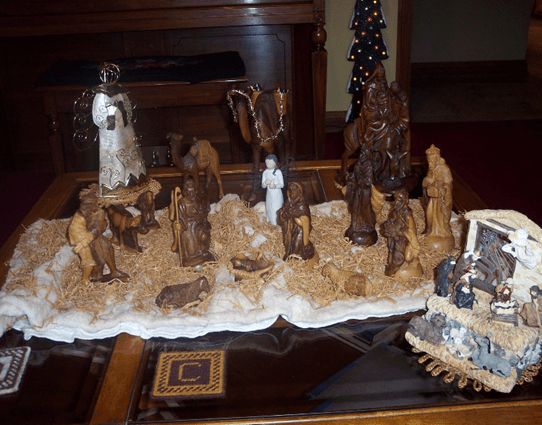
Thanksgiving Day is sacred for the Gearhart family. We do not even listen to Christmas carols before that special day, nor do we start the Hallmark Christmas specials. But the day after: it’s an active time of getting the Christmas decorations out of storage. Paul is the one who distributes the totes to the appropriate rooms, and he untangles the cords of lights and even decorates the outside with lights, a manger scene, and a small tree he proudly found a few years ago. In the family room a lounge chair is moved to the sunporch and an artificial tree stands in that corner space. Becky starts to hang ornaments after she helps Paul strings the lights. Many of the ornaments have been handmade by family members. On the oblong sofa table Becky arranges her manger collection on the upper level. It’s quite a variety––from porcelain-like figures to a handmade Peanuts manger scene. Their cardboard village adorns the lower shelf amid cotton-ball snow.
I get to unpack our tote and put up our manger collection, mostly gifts from friends. Our favorite is made from olive wood, the one Bill bought in Jerusalem many years ago. We also have a wooden Christmas tree with lights that Paul handcrafted for us long before we moved to Indy.
One useful practice is of replacement value. As we move the year-round décor from tables, we pack those items in the emptied totes, ready to display after Epiphany on January 6th. And the next day is Becky’s birthday.
I close with this question: Why decorate if family will not be gathering on Christmas Day? Do the decorations count if only viewed by those who live in our home?
My answer is Yes! Decorations at Christmas seek to focus our attention on God’s greatest gift: Jesus Christ, born of a virgin, lived on our earth, died for our sins, risen to grant us new life.
The last verse of “O Holy Night” exclaims:
Christ is the Lord! O praise His name forever! His pow’r and glory evermore proclaim!
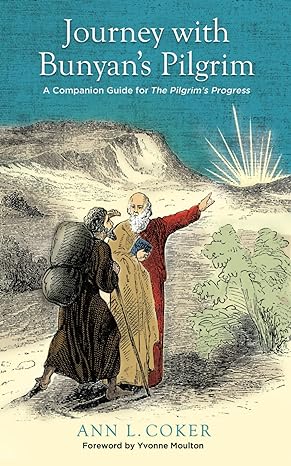
In print after several years of writing, editing, revising again, seeking a publisher, and making one decision after another. The title, Journey with Bunyan’s Pilgrim, did not change throughout the process, but the sub-title went through many changes––until the copywriter, Erin Bartels, convinced me to settle with: A Companion Guide for The Pilgrim’s Progress. Learning from Bunyan’s allegory has been my passion, and now I trust God to guide and sharpen your study of Scripture and apply it to life’s journey.
Many people helped me through the long process, beginning with a group of ladies who studied Bunyan’s book in Touch of Class at World Gospel Church, Terre Haute, Indiana. I’m thankful for their commitment to read this classic allegory with an assignment to keep a journal. My work in process made a debut during Jerry Jenkins Writers Guild, and then developed a book proposal online with Chad R. Allen’s BookCamp, adding critique from members of Heartland Writers Group, Indianapolis.
Staff at EABooks Publishing is top notch, especially Robin Black, the formatter who prepared and sent me several suggested formats before we decided on the best one to match the objective of presentation that included an invitation to journal. When I combined quotes, commentaries, personal devotions, interactions, and questions for reflection, that posed a challenge for format.
And I cannot neglect my thanks for family and friends who encouraged me along the way. It’s been said it takes a village to raise a child. Getting a book into the world is never accomplished without a combination of people who spur on the writer. Yes, a writer’s life can be considered a lonely career, but I would not have come to this point without support. Many people deserve my appreciation, listed here or not. I’ve called myself a writer for years, yet with my name on the front of this published book, I now consider myself an author. Praise Jesus!
Bill and I watched Disney’s animated version of Robin Hood, and right away I recognized the voice of Little John as Phil Harris. He also voiced the bear in Jungle Book, a favorite of our kids. Listen to “Bare Necessities” in the link above, and you’ll get a taste of Phil’s diversity. (To open the link, you might have to use Control and Click.)
But my knowledge and love for Phil Harris goes back to childhood when I listened to radio comedy, including Phil Harris, Jack Benny, Fibber Magee & Molly, and George Burns with his wife Gracie Allen. Gracie was known for her zany retorts in the duet comedy routines with her husband. My mother introduced me to these shows, but her favorite was The Breakfast Club.
In the evenings at home, I would also listen to mystery shows coming through on our upright radio (stood on the floor) with a wooden and screen front. I’d sit in front of this antiquated radio and (to my regret now) I would poke holes with a fingernail file into the cloth screen. My favorite shows included Mr. & Mrs. North, The Creaking Door and Inner Sanctum. The last two were one and the same. These sparked my continued interest in suspense novels.
The sound effects on radio kept me interested, such as when the closet door opened on Fibber Magee & Molly, and I heard items tumble out. Or when the intro to The Creaking Door really squeaked. I looked up Mr. & Mrs. North and found that episodes are on YouTube and a four-episode collection can be ordered on DVD, staring Richard Denning and Barbara Britton. I just might look into that.
Anyway, I hope you enjoyed my short trip down memory lane; and as I look back, these shows gave me, as a pre-teen, some clean-cut humor and intrigue. So listening to Phil Harris sing in the animated kids’ shows, I can rehearse the joys of radio from my youth.
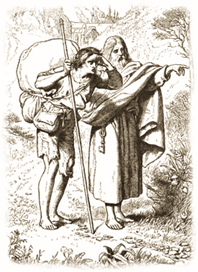
Christian, John Bunyan’s main character in his allegory The Pilgrim’s Progress, has read a book that told him both the problem and the solution. The Bible gave him the reason for the heavy burden on his back and how to get rid of it. Christian met Evangelist and received directions for the start of a long journey to the Gate, the Cross, many fascinating places, and finally to the Celestial City.
You can journey alongside Christian when you combine reading Bunyan’s classic and my companion guide Journey with Bunyan’s Pilgrim, soon to be published. It will be an exciting journey as you encounter obstacles, snags, and people who won’t support you. But you will also have rewarding fellowship with some special travelers, such as Faithful and Hopeful. Their names should be your clue that Bunyan gives meaning to his characters.
Included in my guide is Bunyan’s evident use of Scripture. You will apply Scripture as you take your spiritual journey with Christian, and later with his wife Christiana. Bunyan details the joys and pitfalls any Christian experiences, and thus the journey will be personal as you find biblical truths for life’s circumstances.
The format of my guide is laid out into 13 weeks, six days in each week, making it suitable for individual or group study. The book combines commentary, personal devotions, and an invitation to journal. In journaling you record what’s learned from Scripture and Bunyan’s story––God’s wonderful purpose for His people.
Are you ready to start your journey with Bunyan’s Christian and Christiana? Let me know in the comments and I’ll save my companion book for you when it’s available.
A testimony is a witness to personal experience. It cannot be refuted or explained away. It belongs to one person and need not be duplicated by another. This is my testimony of stewardship. I tell only what I have experienced.
My initial introduction to financial stewardship started at an early age when my sister and I asked Daddy for an allowance. (This was about 1950.) Having thought about it, he handed each of us two quarters and a box of church offering envelopes. He explained that our weekly allowance would be given to us on one condition: one quarter would be given to the church. Both of us agreed; after all, we were one quarter ahead of no allowance.
Then our church started a building fund. Sure enough, Daddy wanted us to give one quarter to the building fund as well. At first our hearts sank. But Daddy increased our allowance to $1.00 and we were happy with the new arrangement. This went on until I began to earn my own money by baby-sitting and selling Christmas cards. By then I found it natural to give a tithe (10%) of my earnings to the church. I’m thankful for parents who taught me to tithe, even though the first arrangement had been 50/50.
This habit held fast when Bill and I got married for Bill had also been taught to tithe. When our church in North Biloxi, Mississippi, began a building program, we set the example for the congregation in giving. In those early years in the pastorate we designated our giving so that it would not come back to us in salary.
Twice I remember we questioned this principle of tithing. First, when Bill began seminary as he pastored a church in Kentucky. We soon rationalized how our income did not amount enough to title; and surely the expenses of seminary could be counted as an offering to the Lord. We vowed instead to tithe our modest income to the church and missions. After all, wasn’t everything we owned a gift from God?
Second, when we moved to Indiana to work with OMS International (currently One Mission Society), we reasoned we would have to delete our personal share support of missionaries. But when we figured out our tithe (on our gross income), we had enough to continue our commitment of giving.
Do you ask about the benefits and rewards of giving? For us, it has meant no sweeping abundance of wealth or material blessings. But God has met our needs, even when dinner meant bread and gravy along with green beans from some parishioner’s garden. Each faith pledge has been met without an unexpected gift, and met by putting God first and using available resources to His glory.
The greatest benefit has been a deep satisfaction in giving back to God a portion of all He has given to us. (See Proverbs 3:5, 6, 9, 27.) That benefit has lasted through the years, and today we continue to praise God for the privilege of being a part of Kingdom work with our finances as well as ministry skills.
Some habits are good while others are not so. As I put a tissue in each pocket this morning, I thought of the reason. On occasion during the day, a tissue from my right pocket will be for me, and the tissue in my left pocket will be for Bill. He carries a handkerchief in his back pocket, but rarely gets it out to use. So I have a tissue ready for him.
On my desk I have a notebook that holds my notes from various web meetings. It’s halfway organized, but still useful. While I cannot attest that I refer back to all those notes, it’s a habit I don’t neglect. Another but smaller spiral notebook has been my safe place for notes of all kinds. This was added recently so I could keep track of reminders, rather than have a bunch of small papers which I’d lose on occasion.
Habits not only benefit me, but they can be appreciated by others. Such as preparations for meals. That can become a dreaded occurrence, thinking about what to serve and then doing the work. But if we’d do away with it, we know it would not be good for us. Bill likes meals on time, and he will point at the clock when it’s noon, even if we just had breakfast three hours ago.
Bad habits don’t always start out that way. We often find out their harm as we continue doing them, or when someone corrects us. That happened recently when I tried to end a text conversation by saying, “Thanks for your input.” It came across to the party as condescending and dismissive. I needed to hear that in order to do better next time. My words were like moving out of a room in a face-to-face conversation. That habit has to be broken, so we can have a better relationship. I’m grateful for the correction.
Developing a routine or rhythm in life can start with habits. Friday (the day I’m writing this) is my laundry day, and others in the household honor that time. It became a routine when we moved to Indy. For Terre Haute I volunteered at the CPC on Fridays. Habits or routines can change to accommodate a set schedule. With Bill’s dementia, having a rhythm is important for his day. He can expect what will happen in a consistent pattern. We could all learn from that.
As I got ready to save this blog post, I found that I had written one on habits in 2018. It must be an important aspect of life. I’ll examine more of my habits. How about you and your habits?
The following paragraphs in quotes were written by our daughter, Becky Gearhart, and posted on her Facebook page:
“I just had a 20 minute ‘conversation’ with my dad. I have absolutely NO IDEA what he was trying to convey. It began with showing me the two locks on the back door. In his mind something was not right about them, although they both seemed to be working just fine. Then he began stringing words together, and in his mind, he was making perfect sense. All I could do was listen and nod…and try not to cry.
“My dad used to teach a class called The Art of Preaching. Gifted with teaching and preaching, he loved to read for knowledge and as a hobby. Words were extremely important to him. He can no longer read, unless it’s put to music, and then he gets most of it right. He usually doesn’t talk much, but when he does, he can’t put together a complete sentence. We often have to try to figure out what he means and try different words or hand gestures if we are trying to say something to him because the words don’t ‘compute.’
“Alzheimer’s disease/Dementia have slowly been taking him farther and farther away. He’s still here physically but my dad is no longer here. It’s a slow death and hard to watch up close.
But God is still good and His mercies never fail. God is still on the throne and He is still sufficient!”
In June our granddaughter, Anna Rhodes, and her family spent two days with us. The triplets, Ethan, Naomi, and Levi, saw up close what dementia looks like by being around their great-grandpa. Since Anna is a psychiatric nurse, it gave the kids opportunity to ask questions and get good information. At one point, Anna showed her kids an x-ray photo on her phone: a healthy brain and a brain affected by dementia. Holes represented spaces left absent in one’s memory.
Since their great-grandpa likes to play solitaire on his computer, the kids would join him, and soon they would take over the games, having good fun with Bill who would occasionally instruct them. Naomi sat near him once while he talked. Afterward, I asked what they talked about. She said it was about what he used to do, doing it right, a common theme.
Anna engaged in a couple of conversations with her grandpa and she was more interactive than I have been. After one talk, I asked Anna how she kept the talk going, how she engaged herself in the conversation. Impressed with her patience and endurance, I needed a few pointers from her. She concentrated on keeping the talk going, whereas I want it to end. Anna would repeat to him some of his words, or give a sense of agreement and appreciation for what he had said. If I can do that, it would please Bill, but it will not be an easy lesson for me to apply. The level of love Anna showed is above her training as a nurse.
In an earlier blog post I wrote about the term “ambiguous loss.” Becky, in her Facebook post, referred to that by saying her dad is here but not here. While Bill is present, what he used to be is now absent. In his talks, we get a picture of what’s not here anymore. His sentences don’t make sense, and we try to figure out what he’s saying.
One evening Bill came into the kitchen as Paul and I prepared supper. Bill started talking about his usual theme of doing what’s right and good. We could clearly get that much as he continued to talk. His serious expression showed this was important to him.
A few mornings later at two o’clock, I awoke to see Bill standing by the bed and talking, again about doing what’s right. As I went over to his side of the bed, he pointed his finger at me and said it would be good for me to do what’s right. He continued to talk as I persuaded him to go to the bathroom. As if in another world, he talked in a subconscious state, but not in his sleep. At breakfast I told Bill he had been preaching. No response. Anyway, it’s a fun story.
We go to doctors’ appointments together. I am my husband’s memory when questions are asked. This has been a gradual thing, starting after Bill’s 24-day hospital stay for Legionnaire’s disease the summer of 2010, two years after his retirement from the pastorate. His neurologist had diagnosed the memory loss due to hardening of the arteries. But I am convinced that the Legionnaire’s disease was also a contributing factor. Being intubated meant Bill received a sedative that may have been too much for too long. His lungs are fine now, but deprivation of oxygen affects every cell in one’s body: brain, eyes, muscles, everything. So he is dealing with both short-term and long-term memory loss.
A few years ago while sitting in the waiting room to see our family doctor for a routine visit, I spied a Q & A sign board on a table. The question: ‟What is needed for caregiving?” Post-it notes offered answers from patients. I wrote out my response, ‟Good Communication,” and put it on the board. For communication to be good, it must be frequent and honest. Throughout this process we have had frequent talks together. When Bill used to talk more, I could vouch that his communication was honest. I’ve often said that Bill’s middle name is ‟integrity.” He has openly faced the reality of his situation. He has admitted he has a problem and doesn’t hide it from anyone.
Over time Bill would tell anyone––family, friend, doctor––when he didn’t know something or had trouble remembering. Short-term memory was the first to be affected: forgetting where an item was stored in the kitchen or bathroom, such as a funnel or Q-tips. Of course, the biggest memory block has been with names of people, events, and things. I pointed this out once to our granddaughter after Bill had delivered a sermon and couldn’t think of the ‟Haystack Revival.” She offered this compliment: ‟Grandpa has such a good vocabulary, he comes up with another word, description, or definition.” He had called it a revival associated with a pile of straw.
Long-term memory loss has also developed over time. I first discovered this when Bill answered a medical history form with numerous questions about past ailments. He asked me to go over the form with him to make sure he answered correctly. Surprised that he had answered ‟no” to the question about depression, I had him backtrack by describing what had happened and the effects. At the time he could make associations, ‟Oh yes, I remember now.” At that stage he only needed prompts to help jog his memory. That would not help him now.
Bill also has skewed memory. When telling the reason why he returned to pastoring: ‟It was because I got tired of teaching and wanted to preach again.” That’s not the whole story. He had actually been released from his teaching position at a college due to his bout with depression. The first time the skewed story happened, I corrected him. Confusion ensued. From then on, I let it go. If that’s how he wants to remember what happened, why not?
How does this affect me? Mainly I have to be careful about my tone of voice when I answer his oft-repeated questions, for he doesn’t always recall that he’s asked me once or twice or more often. Perhaps I patronize him. My biggest problem is that I have unreasonable expectations. I would like this to be different, for life to go back as it was, but we tread on, and with hope.
Our hope is not in the medications or doctors’ analysis, but hope that tomorrow will include something sweet and good, some new avenue of sensing God’s goodness. Our hope is not in a remedy down the road but in the Lord.
Carrollton Avenue United Methodist Church, New Orleans, Louisiana
Dad worked for a steamship corporation first in Mobile, AL, then for nine years in New Orleans, LA, before our family returned to Mobile. In New Orleans we attended Carrollton Ave. United Methodist Church, and that’s where I met Bill, later to become his wife after I graduated from Murphy High School in Mobile and he graduated from Tulane University in New Orleans. Our wedding ceremony, August of 1957 in Mobile, had Bill’s Uncle Bud come from Mississippi to officiate. That will be 66 years ago this August.
Uncle Bud found Bill a supply pastorate in North Biloxi, MS, and that’s where we began our marriage, the very next Sunday after our wedding. The parsonage behind the church was furnished and Bill had a small study where he added a small bookcase assembled by his dad. We still have that bookcase. Bill also secured a teaching job at D’Iberville High School when the principal phoned Bill to ask if he could teach Math. He declined, saying he would be suited better to teach English. The school hired him. For two years Bill preached twice on Sundays, led Bible study on Wednesdays, and taught English on weekdays. Those students have kept in touch with us until this day. For their senior year, Bill and I, along with another couple, led the students on a trip to Monterey, Mexico. Quite an adventure filling us all with lasting memories.
Bill accepted his next appointment in Lucedale, MS, for a four-point charge. That’s four churches in a not-so-distant area. Bill set up a new schedule to preach every Sunday at each church, satisfying their need for consistency and our need to know the parishioners better. After two years there and our second son on the way, Bill applied for ministerial training at Asbury Theological Seminary in Wilmore, KY. Bill got church appointments which provided our family with housing. After two degrees from ATS and two more children, we moved to Indiana and another church assignment while Bill attended Hebrew Union College in Cincinnati. That meant Bill traveling on weekends to fulfill pastoral duties and connecting with family.
Back to Kentucky when called to be a substitute for a professor at ATS on sabbatical. Two years later, Bill with family moved across the street to Asbury College to teach and finish his PhD dissertation from HUC. Not going into details, we later moved to Greenwood, IN, to take staff positions for two years at One Mission Society. Then back to Asbury College when Bill was appointed Vice President of Academic Affairs.
Several years later we moved again to Indiana when Bill accepted a senior pastor position at World Gospel Church in Terre Haute, IN. After 19 years, Bill retired and we stayed on for nine years in a house we had built on 12 acres. During our time there I held a staff position at the local Crisis Pregnancy Center. In 2010 Bill contracted Legionnaire’s disease that accelerated dementia, later being diagnosed with Alzheimer’s disease.
In July of 2017 we decided to move to Indianapolis to live with our daughter, Becky, a nurse, and her husband Paul. Each family sold homes and bought a house together. That’s where we are now with our “East Wing” apartment. We attend Southport Presbyterian Church where Paul is youth director. While we miss friends in former pastorates, we are satisfied with our move, adjusting to life with changes as we age and deal with Bill’s dementia. It’s “new every day.”
From Alabama and Louisiana to Mississippi, with long stops in Kentucky, we have settled in Indiana. From our roots in Wesleyan theology and membership still with the United Methodist Church, we attend a Presbyterian church with good gospel preaching. One former pastor of SPC often teases us by saying, “They let Methodists come here.” I tell him, “Yes, it’s because of you.” Through all these times God has been good to us.
This topic was inspired by a blog post I read from a writer friend Anna Holloway



 Ann Coker