Point of View

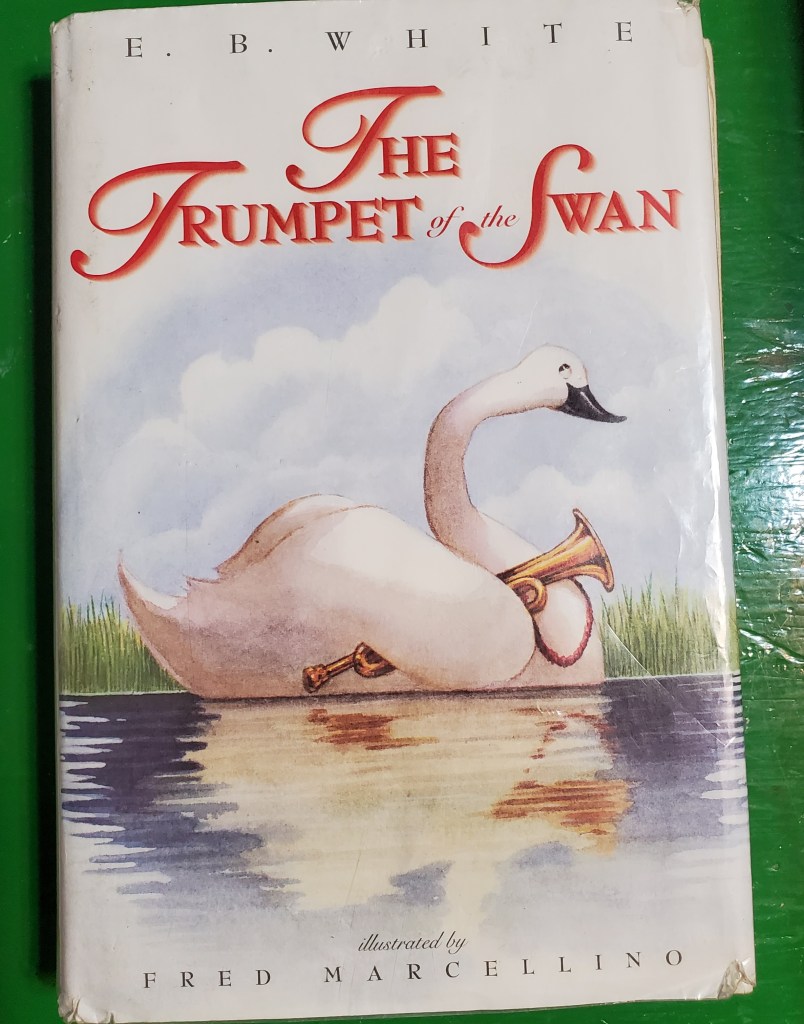
The Trumpet of the Swan by E.B. White, Illustrated by Fred Marcellino

In The Trumpet of the Swan (© 1970) by E.B. White, a young boy discovered two trumpet swans near a pond while camping in Canada. After one visit, quietly viewing the swan on her nest of five eggs, Sam returned to his tent and wrote in his notebook before going to sleep:

   “I don’t know of anything in the entire world more wonderful to look at than a nest with eggs in it. An egg, because it contains life, is the most perfect thing there is. It is beautiful and mysterious. An egg is a far finer thing than a tennis ball or a cake of soap. A tennis ball will always be just a tennis ball. A cake of soap will always be just a cake of soap––until it gets so small nobody wants it and they throw it away. But an egg will someday be a living creature. A swan’s egg will open and out comes a little swan. A nest is almost as wonderful and mysterious as an egg. How does a bird know how to make a nest? Nobody ever taught her. How does a bird know how to build a nest?” (p. 28).

E.B. White has put into a boy’s mind the thoughts of new life. A swan laid an egg and after 35 days of incubation in her nest, a new “living creature,” a baby cygnet swan, comes out of an egg.

The young boy, Sam, observes this mystery and yet his point of view is a mature understanding of life and its beginning. Birth of swans is mysterious and wonderful––from an egg to a cygnet. The birth of a human baby is wonderful and mysterious––from conception in the womb to the birth of an infant human. From conception to birth, a human is always a human. God’s ways are a mystery yet understandable if we only open our hearts and minds to the truth of creation.

Gift of Friendship

Two long-time friends visited me lately and I found them to be a sweet gift from God. First Stefanie came from a conference in Michigan. She had planned the trip to include Indianapolis, because she wanted to be here for Bill’s birthday on June 17. But she did not change her time frame after Bill moved onto Heaven. Her previous visits with us always included a walk with Bill, playing ping pong, and arm wrestling. The latter contests Bill won, and I don’t think she faked her loss. Stefanie told Bill she would be in better shape next time. Because of their good connection, I wondered how we would spend our time together.

Stefanie and I did walk together, surprising me with enough energy to make it around the block using my cane. We also went to a park for a sack lunch and a trail through the woods. She had work to send back to the university in New Zealand, so that gave me time for reading.

One special treat involved Stefanie driving us for a weekend in Terre Haute and Brazil, Indiana– visits with friends from our former days, including Sunday worship at World Gospel Church. Members, surprised to see us, gave many hugs and brief chats to catch up with our lives. Eating with friends added more conversations, showing we are still connected.

With Stefanie still here, Linda arrived for a two-day visit on the way from her 50th Reunion at Asbury College and back home in Wisconsin. I knew Linda and Stefanie would connect well, because both are verbal about their testimony, reciting Bible verses relevant to their spiritual journeys. I admit that’s also convicting. Mealtimes lasted longer than usual due to times of sharing our lives. It also gave me opportunity to talk about Bill, caregiving, and his last days on earth. Both friends found my ramblings of interest as they asked questions.

Yes, I am grateful for friendships that last throughout the years. They are gifts of faith from my Lord. A favorite Bible verse comes to mind, and it’s my way of expressing connection with Jesus. He told His disciples (and us): “I have called you friends” (John 15:15).

Heart of a Pastor

Monday 2/4 – I feel that my “sermon” yesterday was a bust. Speaking on Scripture, I tried to layout what the Bible is (the story of Man & of God’s Redemption of Man), what we should understand in approaching it (linguistic, literary, historical contexts), and how to read it (open heart, seeking mind), critically, interacting with the text; interpretatively (recognizing cultural differences & relating principles to our circumstances) & depending on the Holy Spirit to illuminate the text.

I was too long (as usual) & I don’t think I was able to communicate what I was trying to get across. I really feel that my academic interests keep me from good sermonizing. People are not interested in those things; just how to live.

I have asked the Lord to open some door of service where I can do more of what I’m capable of doing and will do less damage to the church. Or perhaps the better thing would be for me to retire & let WGC find the person who can help them “grow.”

Tuesday – How many times have I felt like I did yesterday!! This a.m. I know that one sermon doesn’t provide a reason to rearrange one’s life. I think of Paul’s statement in 2 Cor. 4:9 – “we are knocked down but not knocked out.” So I’m getting back up, and at age 66 I’m asking the Lord Jesus for three things:

  1. His Spirit to enable me to see Scripture more in its narrative form & not simply from a grammatic-historical perspective. (Maybe that means I need to stop underlining words, etc. except as a means for finding a passage later.)
  2. Help me with this 30 minute rule by “freeing me” from the need to tell everything I know and focusing in on the point that I want to communicate.
  3. To stop my hand from jerking when I write, so that I don’t need to be so slow & deliberate when I write. This primarily for the sake of time & legibility. (Unless this problem has a greater purpose – to remind my whence I’ve come & how my bout with depression has been used to awaken me spiritually.)

William B. Coker, Sr., found in his journal of 2002. I’ve left all his punctuation and structure.

Journey of Becoming

Following are notes from Bill’s journal while attending Academy of Spiritual Formation in 2002.

There are times when I get tired of religion. We live under a microscope looking at ourselves, examining ourselves. Is it well with my soul? Am I pleasing God? How do I become a better person? How should I act? Is this okay; will it not only meet God’s approval but also that of others who are trying to be religious?

Why am I so rotten on the inside? Is it just a witness to my fallenness or the evidence of my humanness? If the former, why doesn’t God take it away? I’ve asked Him to! If it is the latter, why am I feeling guilty?

O yes, I’m on a journey; in the process of becoming, I’m told. Becoming what? A perfect saint? A completed human being? Wholly sanctified? Pure in heart?

I understand that in becoming conformed to the image of Christ, I need to grow in grace and in the knowledge of Him, be led by the Spirit and walk in the light. I know full well that I haven’t arrived; but sometimes I feel that the drag in my life, the guilt that I wrestle with, has more to do with religion than spirituality. I am weary of the judgementalism of those who’ve got “real religion” and my judging others.

As I said, there are times when I get tired of religion, weary of taking my spiritual pulse, checking up on my soul. I just want to live, to love god and others, and anticipate….

Only one more session and the Academy is history. It’s hard to measure what this has meant. Certainly, the whole is greater than the sum of its parts. Its impact is greater than the presenters have shared or the readings we have completed. Perhaps the most significant is the community itself––our times of worship, of being together, even the unstables. Yes, it’s been the people. I’ll miss them; some more than others, but all of them in one way or another.

Back home: We so often take relationships casually, until we face the loss of them. The loss always leaves a hole, which may be partially filled by new ones. But the deeper the relationship the more remaining emptiness. I understand why, as we grow older, the holes increase and the empty places leave a longing for a day of restoration.

Bill took time out from playing solitaire on the computer to read one of his books.

“How Are You Doing?”

Not too often, but often enough, people ask how I’m doing. They refer to my husband Bill’s death in March. My response, “I’m fine. Really.” And I’m not trying to cover up any sadness. Everyone’s grief journey is different, and I’m finding that out while attending weekly meetings of a GriefShare program at our church. I have fresh grief, for my journey has been brief in one way. It’s been only two months since Bill stopped breathing and went Home. But his journey through dementia started over ten years ago, and during that time I’ve been grieving the loss of what he used to be––my husband of 66 years and my pastor many of those years.

Now as I listen to his podcast, I envision sitting in the congregation, learning biblical truth as he preached for 19 years at World Gospel Church in Terre Haute, Indiana. During the past couple of years Bill would get our attention with what we called his “talks.” His main theme was to “do what’s right and good.” Much else he said did not communicate well. Now as I read my Bible, I notice those words of right and good. Such as, “You shall do what is right and good in the sight of the Lord, that it may go well with you” (Deut. 6:18, ESV).

I can testify that God has enveloped me in His peace. “My peace I give to you; not as the world gives do I give to you. Do not let your heart be troubled, nor let it be fearful” (John 14:27, NASB). I cannot explain that, but I want to credit prayers, those from family and friends. Going through my stack of sympathy cards several times, I’ve notice that most of the signers say they are praying for me and my family. It may not be long-standing, but even if they pray once while writing and addressing their cards to me, that has meaning and shows results.

That photo at the top of this blog post, which I shared from a writer friend on my Facebook page, cites the expression on May 4th: “Let the fourth be with you.” The Fourth Person in the fire with the three Hebrew children is our Lord Jesus. Yes, He has been with me, and I would not want to spend one moment without His presence. While what I miss the most about Bill is his presence with me, it would be far worse for me not to have God’s presence abiding in me.

So, how am I doing? Fine. Really. God is with me, moment by moment. I give sincere thanks for your prayers along my grief journey. I have loss because Bill is not here, but he is not lost. I know where he is and one day I will join him in God’s good timing.

Musings on Discipline — Bill Coker (January 2002)

Old Books (not Bill’s bookshelves)

I am thinking still about resolutions for this year. The word that emerges again and again is “discipline.” Disciplines regarding time (back to reading habits when we had no TV hook-up); discipline of my body (preparing my body for the extended time which I want to have); discipline of my spiritual growth (prayer and fasting, maintaining my Greek and Hebrew, reading in the area of spiritual formation from classical literary texts).

All this sounds great but may be too ambitious, the reason why most resolutions fail. Rather than establishing a rigid goal, I want to cultivate this discipline so that should the Lord allow me to be around a year hence, I will see improvement as well as further need for development.

For a new series, I have begun focusing on the Apostles’ Creed. I want to emphasize not only the critical importance of knowing what we believe but also the crisis generated both personally and in the Church – to say nothing of the impact on society and culture – by our failure as Christians to understand our faith and how it is determinative for our values, ethics, morals, and piety.

My reading of Dorothy Sayers’ Creed or Chaos has shaped the direction this series is taking. My reading of Heschel’s Man Is Not Alone is compelling me to look at faith from the aspect of God’s ineffability and man’s “awe,” as well as from revelation contained in the Scriptures.

I am being wonderfully stimulated by this challenge to me personally but am also wrestling with diversions – my need to establish an exercise program; my desire to get some outside work done; my own mental weariness and failure to spend more productive time in my study; my slow reading – along with my pastoral responsibilities (visiting the sick, supervising our youth ministry, developing a strong educational program for children); my involvement with Emmaus; whether or not the pastors’ forum is going to fly; and spending quality time with Ann.

Just thinking about this makes me realize why many pastors drop our or fall into the sin of sloth. I feel the threat of this latter, particularly as I realize there is far more to read (what I wish I had done earlier in my life and what I genuinely want to do now) than I’ll ever be able to accomplish. It would be easy to throw up my hands and say, “forget it,” and become satisfied with doing no more than is absolutely necessary for giving a homily.

[ Gleaned from a journal Bill Coker kept in 2002. ~AC ]

Becoming One

Photo taken by Tabea Gutschmidt outside our home on Hwy. 40, Terre Haute, IN

Opening the linen closet door, I looked at the towels and said, “I can use a blue towel now.” Those had hung on the towel rack for Bill’s use, but no more. With Bill’s death on March 7, 2024, changes are in small increments and often subtle and insignificant within the larger picture.

No longer is Bill on the other side of our queen-size bed or traveling in the passenger side of our car while I drive to church and errands. His chair in our study is empty, and his computer not in use. No longer is he pointing to our clock on the wall to alert me when it’s time for a meal. In church I sit in the third seat from the aisle where Bill sat, leaving two seats for Becky and Paul. At first I occupied his seat at the table, but that felt abnormal, so I moved to my position.

I busy myself going through Bill’s things, distributing them to either family or bagging up his clothes to donate to a local mission. Even the dress clothes will be used by men going for job interviews. Interestingly enough, most family members were more interested in what they can use. One grandson wanted his grandpa’s plastic shirt stays. I like that. Two grandsons-in-law chose several ties, but there are plenty more. Since our first son has the same name as his dad and same initials, his choices seemed appropriate. When my father died, each of us children wanted one of his handkerchiefs as a memento.

While listening to Bill’s podcast episode during breakfast, his photo is on my phone and yet I’m not sad. I’m glad we decided to continue his sermons on Words of Endearment with Bill Coker, thankful that our tech guys thought of recording a brief announcement about Bill’s death and our intention to proceed ahead.

Strangely enough, I’ve had few tears, and I’ve not concentrated on any regrets or shame. Most moist eyes have come when people relate how Bill has influenced their lives. Those thoughts have been verballing expressed and written in the vast number of cards received. It’s touching to receive remembrances from student grads at d’Iberville High School in Mississippi where Bill taught the first two years we were married as he pastored North Biloxi United Methodist Church on the Gulf coast.

Yes, there is loss for me and I think of that when people say, “I’m sorry for your loss.” In another sense, Bill is not lost. I know where he is, and one day I’ll join him. But for now I don’t have to go find him like a “lost object.” He is with his Savior and Lord, rejoicing.

Help Has Steps

Facing new decisions with caregiving, I mentally said, “I need help,” and thought of this cute photo. This child’s face could be my own expression. But now I know help in many and various ways.

“Help” moved me to think of The Pilgrim’s Progress where Pilgrim was stuck in the bog and Help, a person, came to get him out. Help asked, “But why did you not look for the Steps?” with Bunyan’s biblical reference: “When I was in great need, he saved me” (Psalm 116:6).

Pilgrim’s help was available in the steps that would rescue him from the Slough of Despond. Once out of the bog, Help bid him to continue on his way, but first Pilgrim asked why the Slough of Despond was placed along the Way. I relate this tale in my book, Journey with Bunyan’s Pilgrim, and add my takeaway:

“Pilgrim’s question is also one I might ask. Why would such a place of mud and mire be left to hinder a Christian along the way of salvation? The answer Bunyan gave by way of Help can be borne out in my own experience. . . . Asking for help hasn’t slowed down my process but instead given answers to speed me on my way.”

Why do I need Help now? Bill’s Alzheimer’s disease has moved into the advanced stage, and we need to examine Steps to make life easier for him and us as caregivers. Becky, Paul and I talked about next Steps. At first, options included: (1) Changes in furniture and equipment such as a hospital bed and wheelchair, requiring that we move current furniture; (2) Senior Care in-home personal care from a local agency; (2) Move to a memory care unit in an assisted living facility. All are good and cost factors vary. What do we do next and what benefits us best?

While researching the options, we turned to another not exactly on the original list. We have chosen Hospice in-home care, and it’s been the right decision. That means end-of-life care, an honest evaluation. In two days Bill was evaluated and signed up because of two main criteria: lack of mobility and poor communication. A hospital bed was ordered and assembled in our bedroom; a schedule of helpers arranged; and the care we needed lined up. The first day on the schedule brought to our home: RN case manager, social worker, chaplain, and an aide. Each performed suitable and needed tasks with professional skill and gentle care. Of course, I still rely on our daughter with her nursing skill and our son-in-law with his good ideas and encouragement. Many friends and family members have sent loving notes of concern and prayers. Above all, we are grateful for our Lord’s help.

Help is available, and we have followed God’s guidance for the best Steps to take.

It’s Okay

Lunch at Chicago Pizza, Indy 2022

Bill has never been one to give compliments during mealtimes. If asked about the food, he will say, “It’s okay.” If pressed he will add, “I ate it, didn’t I?” And he’s not teasing. Occasionally he’ll give a “good” reply and that’s top on his compliment chart. I’ve thought often of myself as a servant, meeting needs such as nutrition, and not expecting thanks. I know a wife is to be honored above a servant’s role, yet I’m still satisfied to rest in the fact that I meet Bill’s needs.

Because most of our evening meals are now prepared by our daughter Becky, we would like to hear more than “okay.” It’s not going to happen. Bill is stuck in that response. We smile when we hear “good.” If we compare Bill’s response to meals with Paul’s compliments, there’s quite a marked difference. Paul exudes enthusiasm for each meal, not often the same words. He genuinely appreciates his wife’s culinary skills, even knowing proper names for most of her dishes.

What has changed, and is more rewarding, with Bill’s interactions are his expressions of gratitude and love. When I button his shirt sleeve or hand him his plate of lunch, he will say, “Thank you.” And if I don’t respond with, “You’re welcome,” he may repeat his thanks. He’s still teaching me. Bill is also now the one who initiates, “I love you,” or blows a kiss my way.

I’ll take those interactions over “it’s okay” anytime. Over our 66 years together I’ve been blessed, and I continue to be blessed through Bill’s journey with dementia. His “ambiguous loss” is evident each day, for he’s here but not here. He’s present but gone. Yes, our days are challenging, but God is good all the time. God does not forget us, and He supplies goodness, love and gratitude.

Though None Go with Me

Title Page, early edition from the Religious Tract Society, London

In The Pilgrim’s Progress, John Bunyan’s Pilgrim saw the grim reality of what his decision meant to leave a city in ruins, but his main concern focused on salvation, safety now and for eternity. He decided to leave home in search of redemption, as he invited those whom he loved to go with him. When none would go with Pilgrim, it came to a parting of their ways.

“Now he had not run far from his own door, but his wife and children perceiving it, began to cry after him to return” (p. 4, Barbour edition). This scene was based on Lot’s exit from Sodom and the warning the angels gave his family.

“As soon as they [the angels] had brought them out, one of them said, ‘Flee for your lives. Don’t look back, and don’t stop anywhere in the plains’” (Genesis 19:17),

Here Bunyan also introduced the cost of discipleship. If we are not willing to leave mother and father, wife and children, any family member, we cannot follow Christ. (See Luke 14:26, 27.) This reminds me of a seminary student we met years ago.

The student served Bill and me a simple meal in his seminary apartment, but his testimony became the main course. He had come from an Asian country to Kentucky, USA, for ministerial studies, and at quite a cost. He could no longer claim family as his own, for once he declared his allegiance to Christ, his parents disowned him. In a personal way, he introduced me to the persecuted church.

Something for you to think about: Was your conversion viewed by family with joy or disdain? How did that affect your commitment?

~ excerpt from Journey with Bunyan’s Pilgrim by Ann L. Coker