
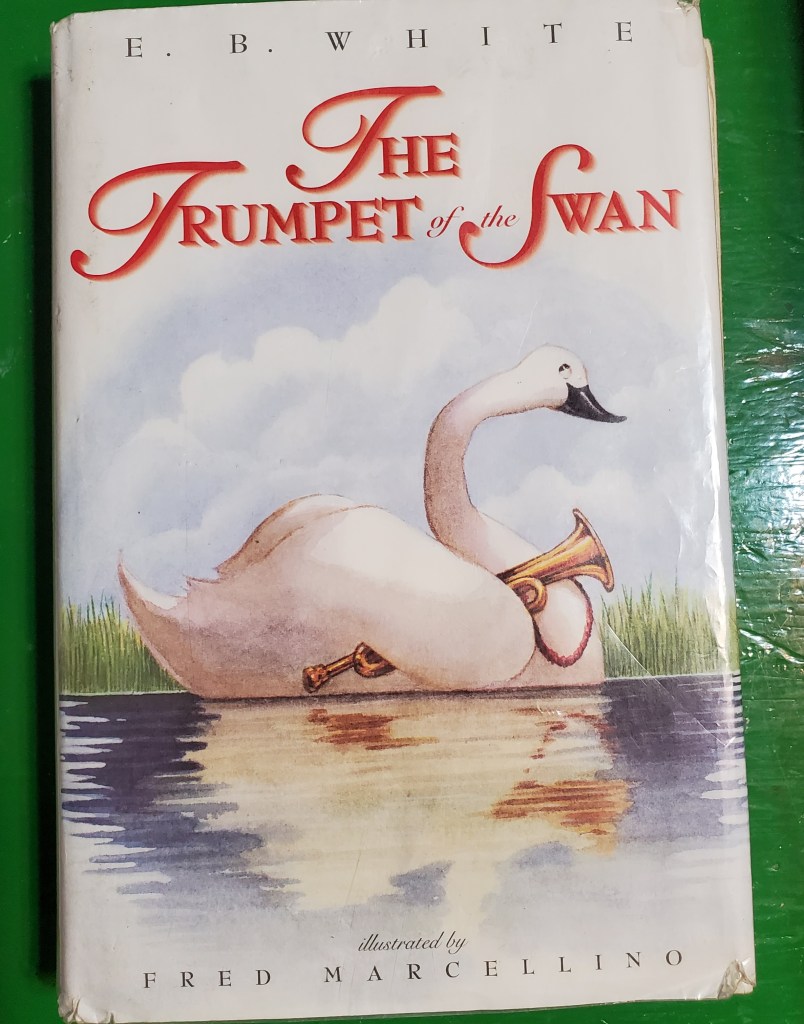
The Trumpet of the Swan by E.B. White, Illustrated by Fred Marcellino
In The Trumpet of the Swan (© 1970) by E.B. White, a young boy discovered two trumpet swans near a pond while camping in Canada. After one visit, quietly viewing the swan on her nest of five eggs, Sam returned to his tent and wrote in his notebook before going to sleep:
“I don’t know of anything in the entire world more wonderful to look at than a nest with eggs in it. An egg, because it contains life, is the most perfect thing there is. It is beautiful and mysterious. An egg is a far finer thing than a tennis ball or a cake of soap. A tennis ball will always be just a tennis ball. A cake of soap will always be just a cake of soap––until it gets so small nobody wants it and they throw it away. But an egg will someday be a living creature. A swan’s egg will open and out comes a little swan. A nest is almost as wonderful and mysterious as an egg. How does a bird know how to make a nest? Nobody ever taught her. How does a bird know how to build a nest?” (p. 28).
E.B. White has put into a boy’s mind the thoughts of new life. A swan laid an egg and after 35 days of incubation in her nest, a new “living creature,” a baby cygnet swan, comes out of an egg.
The young boy, Sam, observes this mystery and yet his point of view is a mature understanding of life and its beginning. Birth of swans is mysterious and wonderful––from an egg to a cygnet. The birth of a human baby is wonderful and mysterious––from conception in the womb to the birth of an infant human. From conception to birth, a human is always a human. God’s ways are a mystery yet understandable if we only open our hearts and minds to the truth of creation.

 Ann Coker