
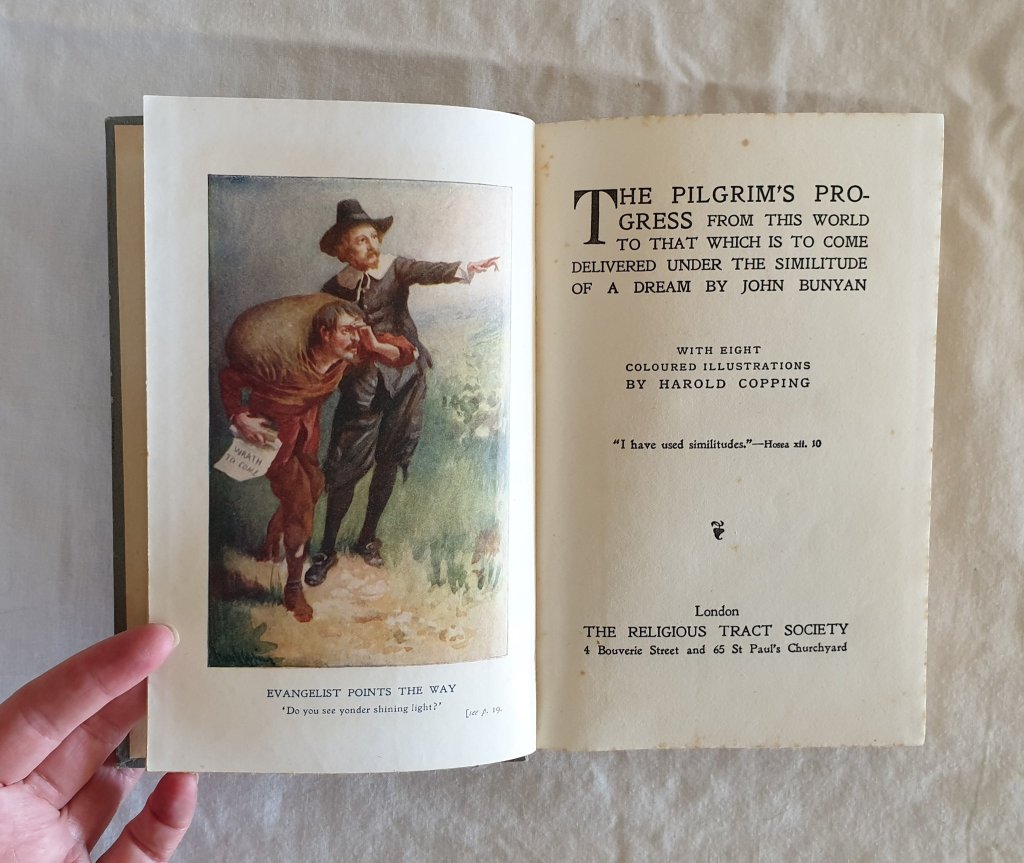
Title Page, early edition from the Religious Tract Society, London
In The Pilgrim’s Progress, John Bunyan’s Pilgrim saw the grim reality of what his decision meant to leave a city in ruins, but his main concern focused on salvation, safety now and for eternity. He decided to leave home in search of redemption, as he invited those whom he loved to go with him. When none would go with Pilgrim, it came to a parting of their ways.
“Now he had not run far from his own door, but his wife and children perceiving it, began to cry after him to return” (p. 4, Barbour edition). This scene was based on Lot’s exit from Sodom and the warning the angels gave his family.
“As soon as they [the angels] had brought them out, one of them said, ‘Flee for your lives. Don’t look back, and don’t stop anywhere in the plains’” (Genesis 19:17),
Here Bunyan also introduced the cost of discipleship. If we are not willing to leave mother and father, wife and children, any family member, we cannot follow Christ. (See Luke 14:26, 27.) This reminds me of a seminary student we met years ago.
The student served Bill and me a simple meal in his seminary apartment, but his testimony became the main course. He had come from an Asian country to Kentucky, USA, for ministerial studies, and at quite a cost. He could no longer claim family as his own, for once he declared his allegiance to Christ, his parents disowned him. In a personal way, he introduced me to the persecuted church.
Something for you to think about: Was your conversion viewed by family with joy or disdain? How did that affect your commitment?
~ excerpt from Journey with Bunyan’s Pilgrim by Ann L. Coker

 Ann Coker